-
Gujarat, India
- info@icontechnology.in
- 24/7 Customer Support
Gujarat, India
Every business wants more customers. But getting a stranger to buy from you does not happen overnight. It takes a clear, structured process-and that process is called a funnel.
A digital marketing funnel is the step-by-step journey a person takes from the moment they discover your brand to the moment they become a loyal customer. It guides potential buyers through different stages, each designed to move them closer to making a purchase.
Understanding your funnel is one of the most powerful things you can do for your business. Whether you run an e-commerce store, a service agency, a SaaS product, or a local business-a well-built funnel is the engine that powers your growth.
Many businesses invest time and money into marketing – running ads, posting on social media, sending emails-but still do not see the results they expect. Why? Because they are missing a clear funnel strategy.
Without a proper funnel, your leads go cold. Your website visitors leave without taking action. Your ad spend goes to waste. And your email list just sits there, unused.
The good news? A well-designed funnel solves all of these problems. And in this guide, you will learn exactly how to build one.
By the end of this blog, you will understand:
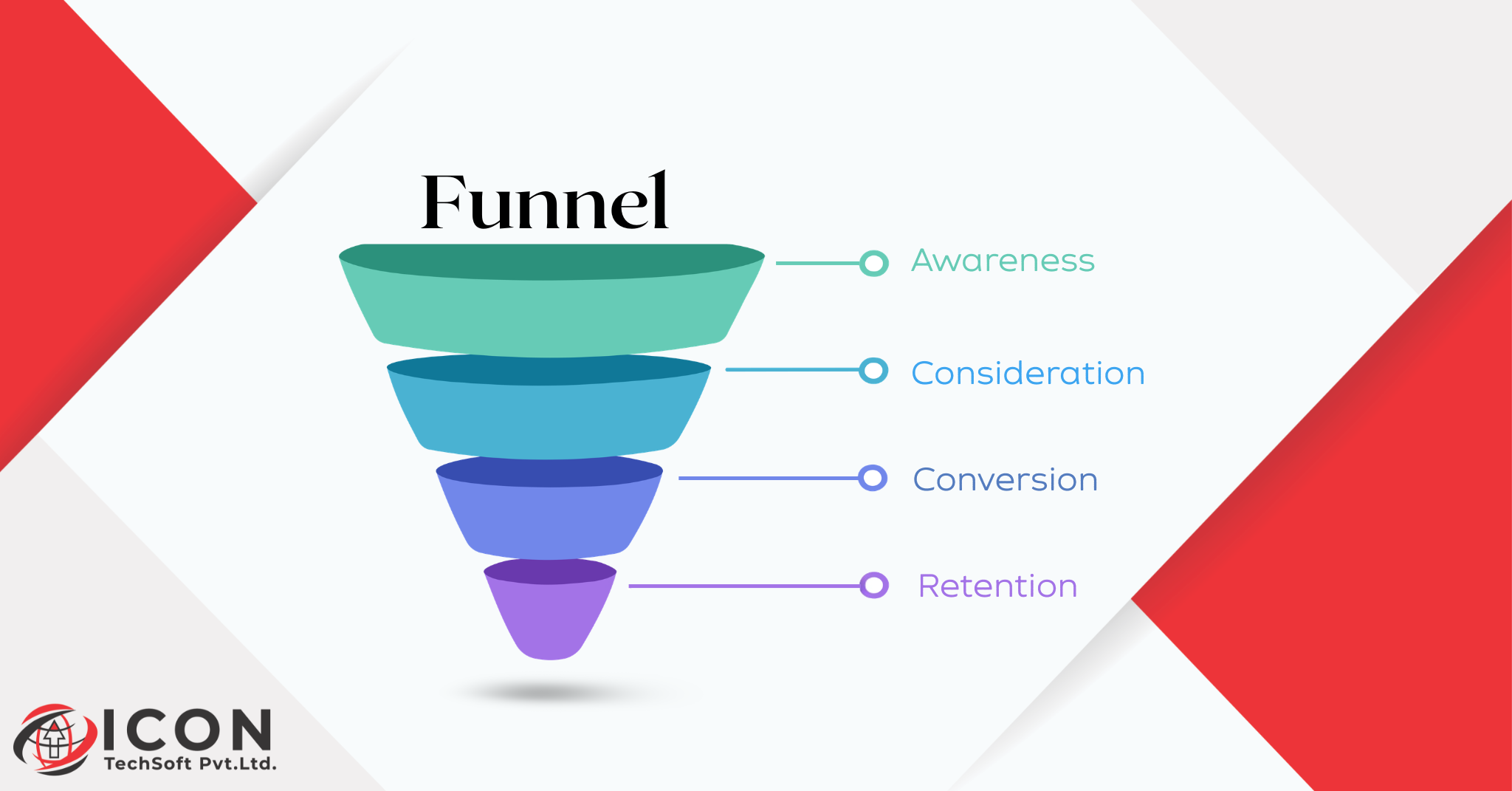
Think of a funnel like this: at the top, you have a large number of people who discover your brand. As they move through each stage, some drop off. And at the bottom, you have the people who are ready to buy.
A digital marketing funnel is a framework that helps businesses attract, engage, and convert their audience online. It covers everything from the first time someone hears about you to the moment they become a repeat customer.
The four key digital marketing funnel stages are:
Let us say you run an online fitness coaching business. Here is how a simple funnel works:
That is a funnel in action-a guided journey that turns a stranger into a customer.
Traditional marketing shouts at everyone and hopes for the best. A digital funnel, on the other hand, is strategic. It delivers the right message, to the right person, at the right time. It is measurable, scalable, and far more cost-effective.
Businesses with a clear funnel strategy see measurable improvements in their marketing ROI. When every stage of the funnel is optimized, you spend less to acquire each customer, and you earn more from each one over time.
A smart funnel also means you stop losing leads in the middle of the journey. You know exactly where people drop off, and you can fix it. That is something traditional marketing simply cannot offer.
Goal: Attract the right audience
This is the top of the funnel. At this stage, your goal is simple-get in front of as many of the right people as possible. These people do not know you yet. They have a problem or a question, and your job is to show up with the answer.
The social media funnel plays a huge role here. Platforms like Instagram, Facebook, YouTube, LinkedIn, and TikTok are powerful channels to build awareness. Combine this with organic SEO through blog posts and YouTube videos, and you have a consistent flow of new visitors entering your funnel.
Key Channels & Content:
Goal: Build trust and nurture interest
The consideration stage is where you deepen the relationship. People know who you are – now you need to prove why you are the best solution for their problem. This is where your email marketing funnel becomes incredibly powerful.
Once someone enters your email list, you can send them a series of helpful, value-driven emails that educate, inspire, and build trust. The goal is not to push for a sale right away-it is to guide them toward making the best decision.
Key Tools & Content:
Goal: Turn leads into paying customers
This is the moment of truth. Your leads are warm. They know you, they trust you, and they are ready to buy – they just need a final push. This is where your landing pages, offers, and calls-to-action (CTAs) need to be sharp and compelling.
A great conversion stage removes all friction and doubt. It uses testimonials, reviews, guarantees, and clear pricing to help the buyer say yes with confidence.
Key Elements:
Goal: Keep customers coming back
Most businesses focus all their energy on getting new customers and forget about the ones they already have. That is a costly mistake. It is far cheaper to retain an existing customer than to acquire a new one.
The retention stage uses CRM tools, automated email workflows, loyalty programs, and personalized offers to keep your customers engaged and happy. A retained customer is also your best source of referrals.
Key Strategies:
You cannot build an effective funnel without knowing who you are building it for. Start by creating a detailed buyer persona – a profile of your ideal customer.
Ask yourself:
When you understand your audience deeply, every piece of your funnel-from your ad copy to your email subject lines-becomes more relevant and more effective.
Your website is the foundation of your funnel. It is where people land after clicking your ad, reading your blog, or following your social media profile. If your website is slow, confusing, or not mobile-friendly, people will leave before taking any action.
Key things to focus on:
Your landing page should have one clear goal. Remove distractions. Every element on the page should push the visitor toward taking that one action-whether it is signing up, downloading something, or booking a call.
A funnel without traffic is useless. Here are the two main ways to drive people into your funnel:
SEO (Organic Traffic):
Write helpful, keyword-optimized blog posts and articles. This takes time, but it builds a sustainable stream of free traffic that grows over time.
Paid Ads (Paid Traffic):
Use Google Ads, Facebook Ads, or Instagram Ads to target your ideal audience instantly. Paid traffic is fast but requires a budget.
Social Media:
Build a presence on platforms where your audience hangs out. Post consistently, engage with your followers, and use your social media funnel to direct people to your lead capture pages.
The best strategy combines both SEO and paid ads, so you have short-term and long-term traffic working together.
Traffic without lead capture is wasted. Once someone lands on your page, you need a way to collect their contact information – usually their email address.
Lead Magnets work brilliantly here. Offer something of value in exchange for their email:
Make sure your lead capture forms are simple, your CTAs are bold and visible, and your offer is irresistible. The easier and more valuable the offer, the higher your opt-in rate will be.
This is where a smart funnel really shines. Once you have someone’s email, you do not sell to them immediately. Instead, you nurture them with a series of strategic emails designed to educate and build trust.
Your email marketing funnel should include:
In parallel, use retargeting ads on Facebook and Google to stay visible to people who visited your site but did not convert. Seeing your brand multiple times builds familiarity and trust.
By now, your leads are warm and ready. Make the conversion process as smooth as possible.
Small details matter here. A confusing checkout page, slow load times, or lack of trust signals can kill a sale at the last moment.
The sale is not the end of the funnel-it is the beginning of a long-term relationship. After purchase, continue delivering value.
You do not need expensive tools to start building your funnel. Here are some popular and effective options across each category:
Website & Landing Page Tools:
Email Marketing & Automation:
CRM Systems:
Analytics & Tracking:
Let us walk through a real-world example of a successful funnel for a digital marketing agency:
The result? A 34% increase in qualified leads and a 22% improvement in conversion rate within 3 months. That is the power of a well-built, data-driven smart funnel.
Test one element at a time – your headline, your CTA button color, your lead magnet offer, or your email subject line. Small improvements in each stage compound into massive results overall.
Use heatmaps (Hotjar), session recordings, and form analytics to understand where users drop off. Fix the friction points, remove distractions, and make the path to conversion crystal clear.
Track your key metrics:
Review these numbers monthly. A well-optimized funnel is never finished – it keeps getting better as you gather more data.
If you are a solopreneur or small business owner with time and a tight budget, you can start building your funnel yourself using tools like Mailchimp, WordPress, and Google Analytics. There are plenty of free resources to guide you.
However, if you want faster results, a more strategic approach, and a professionally built system – investing in a digital marketing agency or funnel specialist is the smarter move. They bring expertise, proven frameworks, and the ability to execute quickly.
A digital marketing funnel is not optional – it is essential. It is the difference between random marketing activity and a strategic system that consistently turns strangers into customers and customers into loyal fans.
Here is what we covered:
Start simple. Build your first funnel, measure what works, and keep improving. You do not need to have everything perfect on day one. The most important thing is to start – because every day without a funnel is a day of missed opportunities.
Your business deserves a marketing system that works for you around the clock. Build your funnel today and watch your leads, sales, and revenue grow.
1. How do I create a digital marketing funnel?
Start by identifying your target audience and their pain points. Then build a landing page, drive traffic using SEO or paid ads, capture leads with a compelling lead magnet, nurture them with an email marketing funnel, convert them with a strong offer, and retain them with CRM and follow-up strategies.
2. Why is my marketing funnel not converting?
Common reasons include weak CTAs, poor targeting, lack of follow-up, slow or confusing website, or irrelevant lead magnets. Run A/B tests, check your analytics, and look at where people are dropping out of your funnel to identify the issue.
3. What is a good conversion rate for a marketing funnel?
Average landing page conversion rates sit between 2% and 5%, while a well-optimised funnel can achieve 10% or higher. Email open rates of 20-30% and click-through rates of 2-5% are generally considered healthy benchmarks.
4. How do I drive traffic to my marketing funnel?
You can drive traffic through SEO (blogging, YouTube), paid ads (Google Ads, Facebook Ads), social media marketing, email campaigns to existing lists, partnerships, and referrals. A combination of organic and paid strategies typically yields the best long-term results.
5. What tools are required to build a marketing funnel?
You will need: a landing page or website builder (WordPress, Webflow, ClickFunnels), an email marketing tool (Mailchimp, ActiveCampaign, ConvertKit), a CRM (HubSpot, Zoho), and analytics tools (Google Analytics, Hotjar). Many platforms combine several of these functions.
6. Do small businesses really need a marketing funnel?
Absolutely. In fact, small businesses benefit the most from a clear funnel strategy because they have limited budgets and cannot afford to waste money on unstructured marketing. A funnel helps small businesses compete effectively, generate consistent leads, and grow sustainably.