-
Gujarat, India
- info@icontechnology.in
- 24/7 Customer Support
Gujarat, India
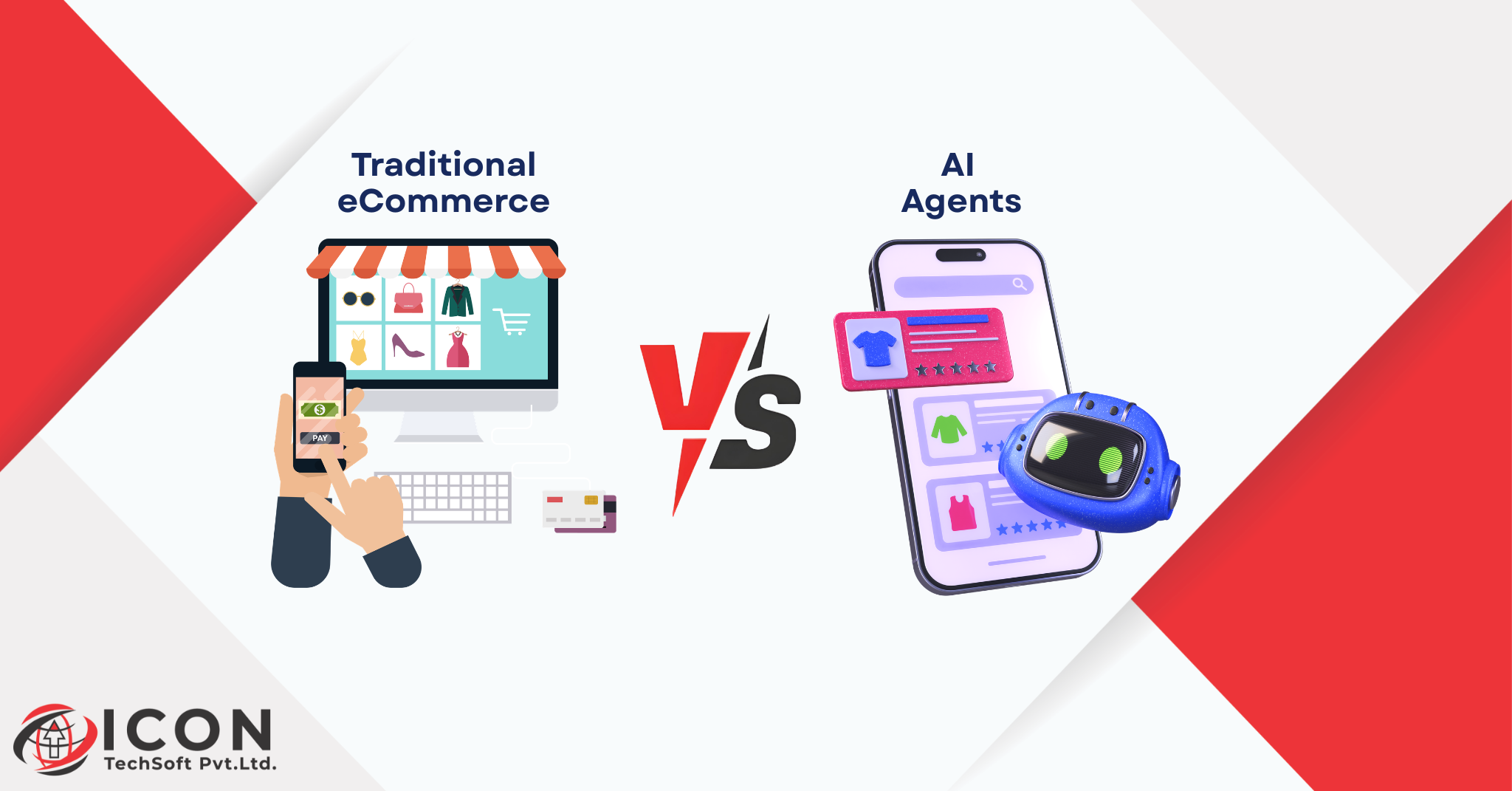
Today, ecommerce AI tools are becoming a major driving force behind digital transformation. Instead of simply following predefined rules, modern AI systems can analyze data, learn from customer behavior, and make intelligent decisions in real time. This shift is creating new opportunities for online retailers to operate more efficiently and provide better shopping experiences.
As AI technology becomes more advanced, businesses are increasingly exploring the role of AI agents in ecommerce. These intelligent systems can handle tasks that once required human intervention, from customer service and product recommendations to demand forecasting and marketing optimization.
At the same time, traditional automation continues to play an important role in running an automated ecommerce store. Many businesses still rely on workflow automation to manage routine processes and maintain operational consistency.
This raises an important question: should businesses continue relying on traditional automation, or should they embrace AI agents?
In this guide, we will explore the differences between AI agents and traditional eCommerce automation, understand how AI is transforming online retail, and examine the future of intelligent eCommerce operations.
Consumer expectations have changed dramatically over the past decade. Customers now expect personalized experiences, instant support, accurate recommendations, and fast delivery.
Meeting these expectations manually is becoming increasingly difficult as businesses grow.
Several factors are driving the adoption of AI in eCommerce:
Modern ecommerce AI tools help businesses address these challenges by analyzing large amounts of data and identifying patterns that humans may miss.
For example, AI can determine:
This ability to make data-driven decisions is one reason why how AI is transforming ecommerce has become a major discussion among business leaders worldwide.
The journey from traditional automation to AI-powered systems has happened gradually.
In the early stages of eCommerce, businesses relied heavily on manual operations. Employees managed inventory, responded to customer inquiries, processed orders, and updated product information manually.
As businesses grew, automation tools emerged to simplify these repetitive tasks.
Traditional automation systems introduced:
These solutions significantly improved efficiency.
However, traditional automation had one major limitation: it could only follow predefined instructions.
For example:
While useful, these systems lacked intelligence.
AI agents represent the next stage in this evolution.
Unlike standard automation, AI systems can:
This evolution is reshaping the way businesses think about ai automation and operational efficiency.
eCommerce automation refers to the use of software tools that perform repetitive business processes automatically.
These systems operate using predefined rules and workflows.
Once configured, automation tools execute tasks without requiring constant human intervention.
Common examples include:
Automation reduces manual workload and helps businesses operate more efficiently.
For many businesses, traditional automation remains the foundation of an automated ecommerce store.
An automated eCommerce store relies on interconnected software systems that handle routine business activities.
These systems are typically connected through:
For example:
A customer places an order.
The system automatically:
This workflow happens automatically based on predefined conditions.
The result is improved efficiency and reduced operational costs.
Many online retailers already use automation technologies in daily operations.
Popular automation categories include:
These tools automate customer communication through:
Inventory systems automatically:
Order processing systems help businesses:
CRM platforms automate:
These technologies form the backbone of many successful automated ecommerce store operations.
Traditional automation offers several advantages.
Increased Efficiency
Routine tasks are completed faster without manual intervention.
Reduced Errors
Automation minimizes human mistakes in repetitive processes.
Cost Savings
Businesses can handle larger workloads without increasing staff.
Consistent Operations
Tasks are executed the same way every time.
Scalability
Businesses can process more transactions efficiently.
Limitations
Despite its advantages, traditional automation has important limitations.
No Learning Ability
Automation follows predefined instructions and cannot learn from experience.
Limited Decision-Making
It cannot evaluate complex situations or make strategic choices.
Rigid Workflows
Changes often require manual reconfiguration.
Limited Personalization
Customer interactions remain rule-based rather than truly individualized.
These limitations are one reason businesses are exploring AI agents vs automation solutions.
AI agents are intelligent software systems capable of performing tasks, making decisions, and adapting to changing situations.
Unlike traditional automation, AI agents do not simply follow fixed instructions.
They can:
Think of traditional automation as a machine that follows a checklist.
Think of an AI agent as a digital assistant that understands the situation and determines the best action to take.
This distinction is central to understanding AI agents in ecommerce.
Traditional software performs exactly what it is programmed to do.
AI agents go beyond programming by using:
For example:
A traditional chatbot may respond with predefined answers.
An AI agent can:
This capability allows AI systems to deliver more personalized and effective customer experiences.
Several trends are fueling interest in AI agents.
Online stores generate massive amounts of customer data.
AI agents can analyze this data quickly and identify valuable insights.
Customers expect personalized recommendations and instant support.
AI agents help businesses meet these expectations at scale.
Businesses need smarter ways to improve conversions and customer retention.
AI agents reduce manual work while improving decision quality.
These benefits explain why many experts believe the future of AI in ecommerce will involve increasingly autonomous systems.
The biggest difference between traditional automation and AI agents lies in how decisions are made.
Traditional automation operates using predefined rules.
For example:
The system cannot deviate from these instructions.
AI agents operate differently.
Instead of relying solely on rules, they evaluate available data and determine the most appropriate action.
For example, an AI agent may:
This intelligence allows businesses to create more responsive and effective workflows.
Traditional automation does not improve over time unless humans update the workflows.
AI agents continuously learn from:
As more data becomes available, AI systems become more accurate and effective.
This learning capability is a major advantage in the debate around AI agents vs automation.
Customer experience has become a key differentiator in modern eCommerce.
Traditional automation provides consistency but often lacks personalization.
AI agents can create highly individualized experiences by:
This leads to:
The impact of how AI is transforming ecommerce is especially visible in customer experience improvements.
As businesses grow, operational complexity increases.
Traditional automation helps manage larger workloads but often requires additional workflows and manual adjustments.
AI agents scale more effectively because they can adapt to changing conditions automatically.
Benefits include:
For rapidly growing businesses, advanced ecommerce AI tools can become a significant competitive advantage.
Traditional automation is generally easier and less expensive to implement.
Businesses can often deploy automation tools quickly with minimal training.
AI agents typically require:
Initial costs may be higher.
However, the long-term benefits often include:
Businesses must evaluate their goals carefully when deciding between traditional automation and AI-powered solutions.
Artificial intelligence is no longer a futuristic concept in online retail. Today, businesses of all sizes are using ecommerce AI tools to improve customer experiences, streamline operations, and increase profitability.
The biggest advantage of AI is its ability to process massive amounts of information and turn that data into actionable insights. Instead of relying solely on historical reports or manual analysis, businesses can use AI to make faster and smarter decisions.
From customer support and marketing to pricing and inventory management, AI is reshaping nearly every aspect of eCommerce.
Let’s explore some of the most important ways how AI is transforming ecommerce in 2026.
Modern consumers expect personalized experiences whenever they shop online.
Generic product suggestions and mass marketing campaigns are becoming less effective because customers want recommendations that match their specific interests and needs.
AI makes personalization possible by analyzing:
Using this information, AI can create highly relevant shopping experiences.
Examples include:
When customers feel understood, they are more likely to make purchases and return for future transactions.
This is one reason why many businesses invest heavily in AI tools for ecommerce businesses.
Understanding what customers may do next provides a significant competitive advantage.
AI systems can analyze customer behavior and predict future actions with impressive accuracy.
For example, AI can identify:
These insights help businesses create proactive strategies.
Benefits include:
Predictive analytics has become one of the most valuable applications of AI agents in ecommerce.
Traditional decision-making often relies on historical reports and manual analysis.
AI changes this process by providing real-time insights.
Instead of waiting for weekly or monthly reports, businesses can respond immediately to changing market conditions.
AI can monitor:
Based on this information, AI can recommend or execute actions instantly.
Examples include:
Real-time decision-making allows businesses to remain competitive in rapidly changing markets.
Customer engagement directly impacts sales, loyalty, and brand reputation.
AI helps businesses create more meaningful interactions throughout the customer journey.
Examples include:
Rather than offering generic experiences, AI helps businesses build stronger relationships with individual customers.
As a result, customer satisfaction and retention often improve significantly.
AI agents are influencing nearly every area of online business operations.
Let’s examine some of the most important applications.
Customer service is one of the earliest and most successful uses of AI in eCommerce.
Traditional customer support often requires large teams and significant resources.
AI-powered support agents can handle thousands of customer inquiries simultaneously.
Common capabilities include:
Modern AI support systems can understand natural language and maintain context throughout conversations.
Benefits include:
Many businesses consider customer support one of the most effective starting points for implementing AI agents in ecommerce.
Product recommendations significantly influence purchasing decisions.
Traditional recommendation systems often rely on simple rules such as:
AI takes recommendations much further.
AI systems analyze:
This enables highly accurate suggestions that increase:
Smart recommendation engines have become essential ecommerce AI tools for modern retailers.
Inventory management remains one of the most challenging aspects of eCommerce.
Too much inventory increases costs.
Too little inventory results in lost sales.
AI helps businesses strike the right balance.
AI forecasting systems analyze:
Using this information, AI predicts future demand more accurately.
Benefits include:
Many businesses now rely on AI-driven forecasting to optimize inventory management.
Pricing plays a critical role in eCommerce profitability.
Traditional pricing strategies often rely on manual adjustments.
AI enables dynamic pricing by analyzing:
The system can automatically recommend or implement pricing changes that maximize revenue and profitability.
Advantages include:
Dynamic pricing represents one of the most powerful examples of ai automation in modern eCommerce.
Marketing is becoming increasingly data-driven.
AI helps businesses improve marketing effectiveness through automation and intelligence.
AI can assist with:
Unlike traditional automation, AI can continuously improve campaigns based on performance data.
This allows businesses to achieve better marketing outcomes with fewer manual adjustments.
Online fraud continues to be a major concern for eCommerce businesses.
Traditional fraud prevention systems often rely on predefined rules.
AI can identify suspicious activity more effectively by recognizing unusual patterns.
Examples include:
AI systems can evaluate thousands of variables simultaneously, making fraud detection faster and more accurate.
Benefits include:
The growing popularity of AI has led to the development of numerous solutions designed specifically for online retailers.
Below are some categories of ecommerce AI tools that businesses frequently use.
Customer service AI tools help businesses provide instant support and improve customer satisfaction.
Common features include:
Popular examples include:
These solutions help businesses deliver faster and more efficient support.
Marketing teams increasingly rely on AI to improve productivity and campaign performance.
Common use cases include:
Popular tools include:
These tools help businesses create and optimize marketing campaigns at scale.
Recommendation engines help increase conversions and customer engagement.
Common features include:
Popular platforms include:
Inventory optimization is becoming increasingly dependent on AI.
These systems help businesses:
Examples include:
Sales optimization platforms use AI to identify growth opportunities.
Capabilities include:
Popular solutions include:
These tools help businesses maximize sales performance while reducing manual analysis.
Despite the rise of AI, traditional automation remains highly valuable for many business operations.
In fact, most successful online stores continue using both technologies.
Traditional automation performs repetitive tasks extremely well.
Examples include:
These activities do not require advanced decision-making and can be automated efficiently using rule-based systems.
Many business processes follow predictable workflows.
Traditional automation is ideal for:
These workflows benefit from consistency and reliability.
Order fulfillment remains one of the strongest applications of traditional automation.
Automated workflows can:
This helps maintain operational efficiency within an automated ecommerce store.
Email automation continues to deliver strong results for online businesses.
Common examples include:
These processes are highly structured and do not always require AI-driven decision-making.
Traditional automation remains cost-effective and reliable for these tasks.
The reality is that AI does not completely replace automation. Instead, businesses are discovering that combining intelligent AI capabilities with proven automation workflows often delivers the best results.
The discussion around AI often sounds theoretical, but many businesses are already using AI agents to solve real-world challenges. From customer support and inventory planning to marketing and sales optimization, AI agents are delivering measurable results across the eCommerce industry.
As more businesses adopt ecommerce AI tools, the practical applications continue to expand.
AI shopping assistants are becoming increasingly popular among online retailers.
These intelligent assistants help customers find products faster and make informed purchasing decisions.
Unlike traditional search tools, AI shopping assistants can:
For example, if a customer asks for a laptop suitable for graphic design under a specific budget, an AI assistant can analyze available products and provide personalized recommendations.
Benefits include:
This is one of the most visible examples of AI agents in ecommerce improving the customer experience.
Customer support teams often handle thousands of repetitive inquiries every month.
AI-powered service agents can automate a significant portion of these interactions.
These agents can:
Modern AI systems can understand natural language and maintain conversation context, making interactions feel more human and helpful.
Advantages include:
As customer expectations continue to rise, autonomous support agents are becoming a critical component of modern eCommerce operations.
Inventory management requires constant monitoring and accurate forecasting.
AI-powered inventory agents help businesses make smarter stocking decisions.
These systems can:
By using predictive analytics, businesses can reduce excess inventory while avoiding stockouts.
This improves:
Many organizations now view AI inventory management as one of the most valuable AI tools for ecommerce businesses.
Marketing and sales teams generate enormous amounts of data.
AI agents help convert this data into actionable insights.
They can:
Instead of relying solely on historical reports, AI agents continuously analyze performance and suggest improvements.
Benefits include:
This is another powerful example of how AI is transforming ecommerce.
Although AI offers significant benefits, implementation is not always simple.
Businesses must understand potential challenges before investing in AI solutions.
AI systems depend heavily on data.
Poor-quality data can negatively impact results.
Common issues include:
Businesses often need to improve data management before implementing advanced AI solutions.
Successful AI adoption requires:
Without a solid data foundation, AI performance may be limited.
AI implementation often requires greater investment than traditional automation.
Costs may include:
Small businesses may initially find these costs challenging.
However, many organizations discover that long-term benefits outweigh the initial investment through:
Businesses should carefully evaluate potential return on investment before adopting new AI technologies.
Customer data is one of the most valuable assets in eCommerce.
AI systems frequently process large volumes of personal and transactional information.
This creates important considerations related to:
Businesses should establish clear policies regarding:
Strong governance practices help reduce risks while maintaining customer confidence.
Technology alone does not guarantee success.
Employees must understand how to work effectively with AI systems.
Common challenges include:
Organizations should invest in:
When employees understand the benefits of AI, adoption becomes much smoother.
One of the biggest misconceptions is that businesses must choose between AI and automation.
In reality, many successful companies use both.
Traditional automation excels at handling structured, repetitive tasks.
AI agents excel at:
Combining these strengths often creates the most effective solution.
A hybrid approach combines automation efficiency with AI intelligence.
For example:
Traditional automation may:
Meanwhile, AI agents may:
Together, these technologies create a more powerful operational framework.
Businesses adopting hybrid strategies often achieve:
The goal is not to replace existing automation systems.
Instead, businesses should identify opportunities where AI can enhance existing workflows.
Examples include:
Automation sends campaigns.
AI determines the best audience and timing.
Automation routes tickets.
AI resolves customer inquiries.
Automation updates stock levels.
AI predicts future demand.
Automation applies pricing rules.
AI recommends optimal pricing strategies.
This combination helps businesses maximize the value of both technologies.
Organizations considering AI adoption should follow several best practices.
Begin with one or two high-impact use cases.
Examples include:
Clean, accurate data is essential for successful AI implementation.
Establish measurable objectives such as:
Track performance continuously and adjust strategies as needed.
Expand AI usage after demonstrating success in initial projects.
These practices reduce risk while improving long-term outcomes.
The next few years are expected to bring significant changes to online retail.
AI capabilities continue to evolve rapidly, creating new opportunities for businesses.
Understanding the future of AI in ecommerce can help organizations prepare for upcoming changes.
Several trends are shaping the future of online commerce.
Conversational Commerce
AI-powered assistants will become more capable of guiding customers throughout the buying process.
Advanced Predictive Analytics
Forecasting systems will become increasingly accurate and proactive.
Multimodal AI
Future systems will understand text, images, voice, and video simultaneously.
Autonomous Business Operations
AI will manage more operational processes with minimal human intervention.
These trends are expected to drive widespread adoption of advanced ecommerce AI tools.
One of the most exciting developments is the emergence of autonomous online stores.
These stores may eventually use AI to manage:
Human teams will continue providing oversight, but many day-to-day decisions could become increasingly automated.
This represents a significant shift in how online businesses operate.
Personalization is expected to become even more sophisticated.
Future AI systems may deliver:
This level of personalization can significantly improve customer satisfaction and loyalty.
As AI continues to advance, hyper-personalization may become a standard expectation rather than a competitive advantage.
Businesses that embrace AI strategically are likely to gain important advantages.
Potential benefits include:
Organizations that delay adoption may struggle to keep pace with evolving customer expectations and competitive pressures.
This is why many industry experts view AI agents in ecommerce as a key component of future business success.
Businesses interested in AI should approach adoption strategically.
The following steps can help create a successful implementation plan.
Start by identifying areas where AI can create the greatest impact.
Evaluate:
Understanding current challenges helps prioritize opportunities.
Not every solution is appropriate for every business.
When evaluating ecommerce AI tools, consider:
Selecting the right tools improves the likelihood of successful implementation.
Develop a clear implementation plan that outlines:
A structured roadmap reduces uncertainty and supports long-term success.
Continuous measurement is essential.
Monitor metrics such as:
Regular analysis helps determine whether AI initiatives are delivering expected results.
What are AI agents in eCommerce?
AI agents are intelligent software systems that can analyze data, make decisions, learn from interactions, and perform tasks such as customer support, product recommendations, inventory forecasting, and marketing optimization.
How do AI agents differ from traditional eCommerce automation?
Traditional automation follows predefined rules and workflows, while AI agents can learn, adapt, analyze context, and make intelligent decisions based on real-time data.
Can AI agents improve online store sales and conversions?
Yes. AI agents can improve personalization, product recommendations, customer engagement, and marketing effectiveness, which often leads to higher sales and conversion rates.
What are the best ecommerce AI tools for businesses?
Popular options include AI-powered customer service platforms, recommendation engines, inventory forecasting systems, content creation tools, and sales optimization platforms.
How is AI transforming eCommerce in 2026?
AI is transforming eCommerce through personalized shopping experiences, predictive analytics, intelligent customer support, dynamic pricing, marketing automation, and autonomous decision-making.
Can AI agents automate customer support and marketing tasks?
Yes. AI agents can answer customer inquiries, manage support requests, personalize marketing campaigns, optimize advertising, and automate customer engagement activities.
Can AI agents and traditional automation work together?
Absolutely. Many businesses achieve the best results by combining AI intelligence with traditional automation workflows in a hybrid strategy.
What are the challenges of implementing AI in eCommerce?
Common challenges include data quality issues, integration complexity, implementation costs, privacy concerns, and employee training requirements.
What should businesses consider before adopting AI agents?
Businesses should evaluate their goals, available data, budget, technical infrastructure, integration needs, and expected return on investment.
What is the future of AI in eCommerce?
The future includes autonomous online stores, advanced predictive analytics, conversational commerce, hyper-personalization, and increasingly intelligent business operations.
The debate between AI agents and traditional automation is not about determining a single winner.
Traditional automation remains highly effective for structured, repetitive tasks such as order processing, workflow management, and notification systems. It provides consistency, reliability, and operational efficiency.
AI agents, however, introduce capabilities that traditional automation cannot match. They can learn from data, understand customer behavior, make intelligent decisions, and continuously improve performance over time.
For businesses seeking greater personalization, predictive insights, and scalable growth, modern ecommerce AI tools offer significant advantages.
The ideal approach often involves combining both technologies to create a balanced and efficient operating model.
The eCommerce industry is entering a new era where intelligence and automation work together.
As AI automation continues to evolve, businesses will gain access to more powerful tools capable of transforming customer experiences and operational performance.
Organizations that embrace AI agents in ecommerce today will be better positioned to compete in tomorrow’s marketplace.
Whether your goal is improving customer support, optimizing inventory, increasing sales, or building a smarter automated ecommerce store, AI offers opportunities that were unimaginable just a few years ago.
The future of online retail will not be powered by automation alone. It will be driven by intelligent systems that can learn, adapt, and make better decisions. Businesses that invest in the right AI tools for ecommerce businesses today will be the ones leading the future of digital commerce.