-
Gujarat, India
- info@icontechnology.in
- 24/7 Customer Support
Gujarat, India
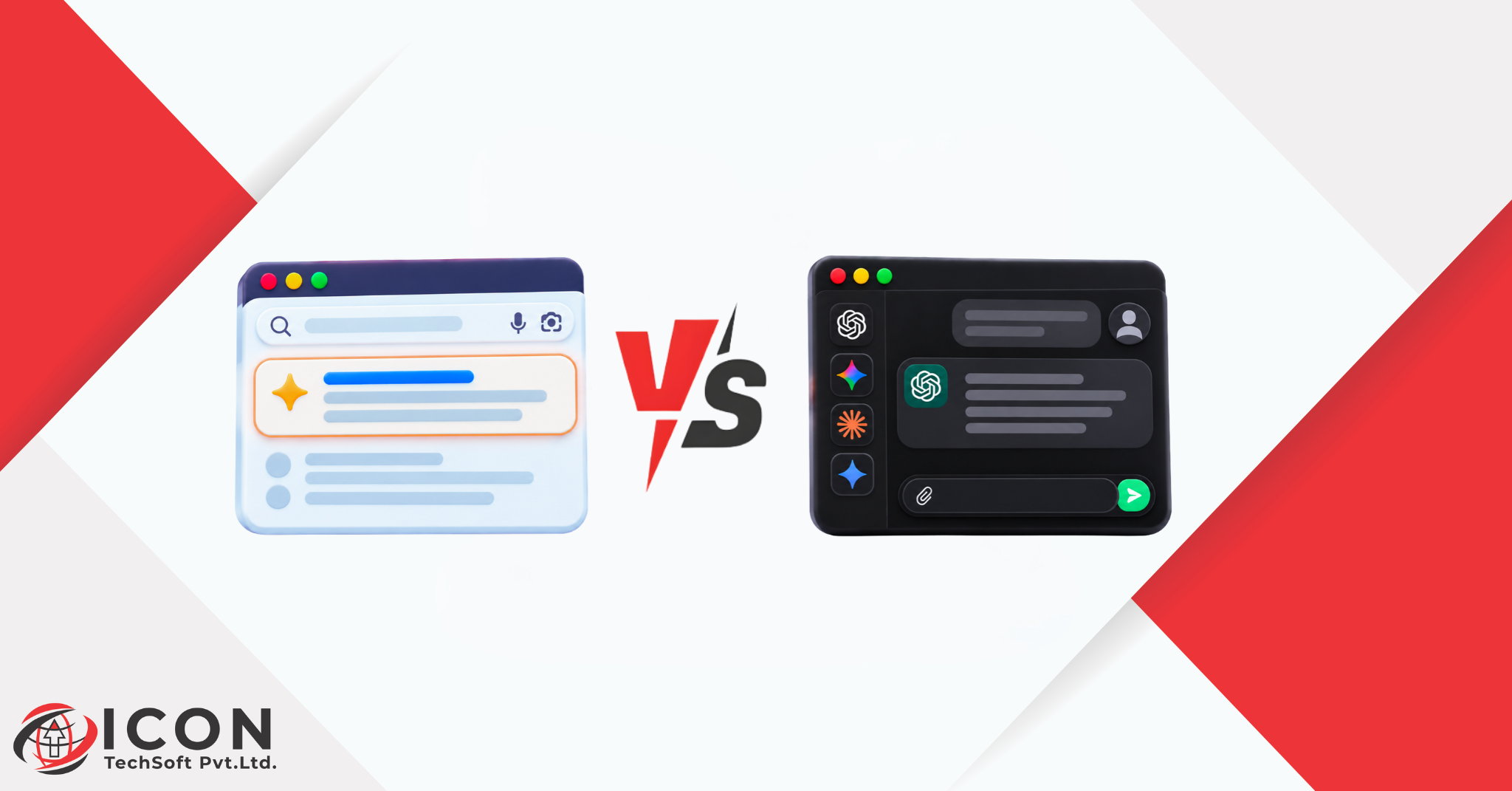
Not long ago, search was simple. You typed a few words into Google, saw ten blue links, and clicked the one that looked best. Businesses worked hard to rank on that first page, and traffic followed. That world still exists, but it is no longer the only one.
Today, people ask full questions. They type them into Google, speak them to a voice assistant, or paste them into a chatbot. And what they get back is often not a list of links. They get a direct answer, a short summary, or a full explanation written on the spot. Tools like Google AI Overviews, ChatGPT, Perplexity, Gemini, and Copilot are now part of how millions of people find information every day.
This shift has created two new terms that every marketer is hearing: AEO and GEO. The debate around AEO vs GEO is growing fast, because many business owners are confused. Are they the same thing? Do you need both? Is this just a new name for SEO?
The short answer is no, they are not the same thing, and no, this is not just a rename. The difference between AEO and GEO is real, and understanding it can help your brand show up where your customers are actually looking.
In this guide, we will explain AEO vs GEO in plain words. You will learn what each one means, how do AEO and GEO work, where they overlap, and how to improve visibility in AI search step by step. We will also look at how AI SEO is changing digital marketing, which mistakes to avoid, and how to pick the right plan for your business.
If you offer SEO services or you are hiring a team to handle them, this guide will help you ask better questions and make better choices.
AEO stands for Answer Engine Optimization. It is the practice of shaping your content so that search tools can pick it as the direct answer to a user’s question.
Think about what happens when you ask your phone, “How long does it take to boil an egg?” You do not want ten links. You want one clear answer, and you want it right now. Answer engines are built for this. They pull a short, clear piece of information from a trusted page and show it at the top of the results or read it out loud.
AEO is about becoming that source. It focuses on questions and answers, and it helps your content win spots like featured snippets, People Also Ask boxes, voice search results, and knowledge panels.
Answer engines look for content that matches a question closely and answers it without confusion. To do this, they scan pages for a few things.
First, they look for a clear question, often in a heading. Second, they look for a short and direct answer right below it, usually between 30 and 60 words. Third, they check whether the page is trustworthy and well organized. Finally, they use structured data, also called schema markup, to understand what each part of the page means.
Here is a simple example. Suppose you run a blog about accounting software. You write a heading that says, “What is the difference between cash and accrual accounting?” Right below it, you give a plain two-sentence answer. Then you add more detail in the paragraphs that follow. An answer engine can easily lift that short answer and show it to a user. That is AEO at work.
So when people ask how do AEO and GEO work, the AEO half of the answer is this: you make your content easy to find, easy to read, and easy to quote as a direct answer.
AEO has a few clear traits that set it apart.
AEO can help a business in several ways. When your answer appears at the top of a results page, your brand gets noticed before any competitor. That builds trust, because people tend to believe the source that gives the answer.
AEO also helps you reach voice search users. As more people use smart speakers and phone assistants, being the spoken answer becomes valuable. It also improves your content quality overall. When you write clear answers for people, your readers stay longer and understand more.
Another benefit is that AEO often brings more qualified visitors. Someone who sees your answer and still clicks through is usually serious about learning more or buying.
GEO stands for Generative Engine Optimization. It is the practice of making your content easy for generative AI tools to understand, trust, and include in the answers they create.
Here is the key idea. A generative engine does not just pick one answer from one page. It reads many sources, combines what it finds, and writes a brand new response. When you ask ChatGPT or Perplexity for the best project management tools for a small team, it may mention several brands, explain their strengths, and cite a few websites. GEO is about getting your brand mentioned, cited, and described correctly in those responses.
This is a different goal from ranking number one. In GEO, you are not fighting for a single slot. You are trying to become part of the story that the AI tells.
Generative AI tools use large language models. These models are trained on huge amounts of text, and many of them also search the web in real time to get fresh facts. When a user asks a question, the tool gathers information from trusted sources, finds common patterns, and writes an answer.
To be included, your content needs to be easy for the model to understand and worth trusting. That usually means a few things.
So when someone asks how do AEO and GEO work, the GEO half of the answer is this: you build content and brand signals that make AI tools feel confident about including you in the answers they write.
GEO has its own set of traits.
GEO helps your brand appear in the places where more and more buying decisions begin. Many users now ask AI tools for recommendations before they ever visit a website. If your brand is part of those recommendations, you gain trust at a very early stage.
GEO also builds long-term brand strength. The work you do, like earning mentions, publishing expert content, and keeping your facts accurate, helps your reputation everywhere, not just in AI tools. And because many competitors have not started yet, early action can give you a real advantage.
Now let us get to the heart of the topic. The difference between AEO and GEO comes down to how the answer is created and what you are trying to win. Both fall under the larger umbrella of AI SEO, but they aim at different outcomes.
Here is a quick view of AEO vs GEO before we go deeper.
The main goal of AEO is to become the direct answer. You want your page to be the one that a search tool quotes or reads aloud. It is a precise goal, and the win is easy to see: your content is in the answer box.
The main goal of GEO is to be part of the generated answer. You want AI tools to know who you are, trust you, and name you when they build a response. The win is less visible, because the answer may change from one user to the next. But the effect on brand awareness can be large.
Put simply, AEO asks, “Can I be the answer?” and GEO asks, “Can I be in the answer?”
In AEO, the result is usually short and direct. It might be a featured snippet, a short list, a table, or a voice reply. The user sees one source and often gets what they need without scrolling.
In GEO, the result is a written response that blends many ideas. It may include a few sources, brand names, and a short explanation. Users can often ask follow up questions, and the answer changes as the chat continues. Because of this, GEO results feel more like a conversation than a search page.
The way you write and organize content is a big part of the difference between AEO and GEO.
For AEO, you write in a question and answer style. You place a short answer right under a clear heading. You use bullet points, numbered steps, and simple tables. You add FAQ sections and FAQ schema so machines can read each question and its answer without effort.
For GEO, you go wider and deeper. You cover a topic from many angles, include fresh facts and expert opinions, and show clear proof of what you claim. You also work on how your brand is described across the web, including reviews, guest articles, directories, and news mentions. The goal is to give AI tools many reasons to trust you.
A smart AI optimization plan blends both styles. Each page has clear answers at the top and rich support below.
Search intent means the reason behind a search. AEO and GEO serve slightly different intent.
AEO mostly serves quick, specific needs. People want a fact, a definition, a step, or a yes or no. Examples include “What is schema markup?” or “How many ounces in a cup?”
GEO mostly serves bigger, more open needs. People want comparisons, advice, ideas, and summaries. Examples include “What is the best CRM for a small business in the UK?” or “How should I plan a website redesign?” These questions need a longer response, and generative tools are built to give it.
Understanding this helps you decide which content deserves a short answer format and which deserves a deeper guide.
AEO works mostly with traditional search features and voice tools. Think Google featured snippets, People Also Ask, Google Assistant, Siri, and Alexa. These systems depend heavily on structured data and well formatted pages.
GEO works with AI search engines and chat tools built on large language models. Think ChatGPT, Gemini, Perplexity, Claude, Microsoft Copilot, and Google AI Overviews. These tools use language models, web retrieval, and a wide set of sources to create their answers.
The line between the two is not perfect. Google AI Overviews, for example, sits in the middle. It shows up on a normal search page, but it is generated by AI. This is why many teams treat AEO and GEO as two sides of one bigger strategy.
Measuring AEO is more direct. You can track featured snippets, People Also Ask appearances, voice search visibility, click through rate, and rankings for question based keywords. Most SEO tools already show these numbers.
Measuring GEO is harder, because AI answers vary. Still, there are useful ways to track progress.
Because both are still young, it helps to track a mix of numbers and keep notes over time.
After reading about AEO vs GEO, you might think you have to choose one. In real life, they support each other. Most good AI SEO plans use both.
Traditional SEO is still the base. It covers keyword research, technical health, site speed, mobile friendliness, quality content, and backlinks. Without a healthy website, neither AEO nor GEO will work well.
AEO sits on top of SEO. It takes your good content and shapes it into clear, quotable answers. GEO also sits on top of SEO, but it adds brand authority, wide topic coverage, and mentions across the web.
You can picture it like a house. SEO is the foundation. AEO is the clear signage that tells visitors where to go. GEO is the reputation that makes people talk about your house to others.
Many of the same actions help all three. Clear writing, strong expertise, good structure, and a trustworthy site help every part of your search presence. That is why pages that do well in traditional search often do well in AI search too.
Using only AEO may get you into snippets, but you could miss the growing number of people who ask chatbots for advice. Using only GEO may build brand mentions, but you could lose the quick wins that come from clear answer formatting.
When you use both, you cover more of the customer journey. A person may first learn about your brand from an AI summary, then search your name on Google, then see your answer in a snippet, and finally visit your site to buy. Each step supports the next.
This is also why many companies now look for SEO services that include AI SEO, not just old style ranking work. A partner who understands AEO vs GEO can help you plan for every place your audience searches.
This is the part most readers are waiting for. If you want to know how to improve visibility in AI search, focus on the steps below. They work for AEO, for GEO, and for classic SEO too.
Start with your audience. List the questions your customers ask before they buy. Use your sales calls, support emails, social comments, and search tools to find them. Then write content that answers each question clearly.
A simple method works well. Put the question in a heading. Give a short, direct answer in the first two sentences. Then expand with examples, steps, and details. This helps answer engines quote you, and it helps generative tools understand your point.
Avoid fluff. Do not stretch a simple answer across five paragraphs. Be helpful first, and add depth where it truly helps the reader.
Schema markup is code that tells machines what your content means. It can label a page as an article, a product, a how to guide, a review, a local business, or an FAQ.
Useful types include FAQ schema, HowTo schema, Article schema, Organization schema, and Product schema. When you add them correctly, search tools and AI systems can read your pages with less guesswork.
You do not need to be a developer to start. Many website platforms and plugins can add schema for you. Just be sure to test your pages with a structured data testing tool and keep the markup honest. It should match what people can actually see on the page.
AI search engines read content differently from older systems. They look for clear meaning, clean structure, and strong support for claims. Here is how to prepare.
Good AI optimization is not about tricks. It is about making your best content easy to understand and easy to trust.
Generative tools lean on sources that appear credible across the web. If only your own website talks about you, that is a weak signal. If many trusted sites mention you, that is a strong one.
You can build mentions in a few honest ways.
Over time, this builds the kind of reputation that AI tools notice.
E-E-A-T stands for Experience, Expertise, Authoritativeness, and Trustworthiness. It is a framework Google uses to judge content quality, and it matches what AI tools seem to prefer as well.
To strengthen these signals, show who is behind your content. Add author names, short bios, and credentials. Share real examples from your work. Link to reliable sources. Display clear contact details, an about page, and customer proof such as case studies and testimonials.
Trust is the center of it all. If a reader or a machine cannot tell whether your information is reliable, they will choose another source.
AI tools care about fresh and correct information. Old statistics, outdated prices, and broken links weaken your pages. Set a schedule to review your most important content. Update facts, add new examples, and remove anything that is no longer true.
Also check how AI tools describe your brand. If they say something wrong, look for the source of the mistake. It may be an old directory listing or an outdated article. Fix what you can, and publish clear, accurate information on your own site.
AI SEO is the wider practice of adapting search strategy to a world shaped by artificial intelligence. AEO and GEO are two major parts of it. Let us look at why this matters.
AI search engines are no longer a small experiment. Major search platforms now place AI summaries on regular results pages, and standalone AI tools keep gaining users. People use them for research, shopping, travel plans, health questions, and work tasks.
Because these tools give complete answers, some users never click a link. That means fewer visits for some types of content, especially simple facts. But it also means that the brands named inside those answers gain a lot of trust. The game is shifting from clicks alone to clicks plus visibility and reputation.
Customers now discover brands in new ways. A buyer might ask an AI tool for a shortlist of vendors, read the summary, and then visit only two or three sites. In the past, that same buyer might have opened ten tabs from a search page.
This makes the first impression more important. If you are not part of the AI answer, you may never enter the buyer’s list at all. On the other hand, if you are named and described well, you start with an advantage.
Customer journeys are also becoming more conversational. People ask follow up questions, compare options, and refine their needs inside one chat. Content that explains things clearly and covers related questions fits this style best.
Sticking only to old methods carries risk. Rankings alone no longer tell the full story. A page can rank well and still lose attention to an AI summary above it.
Adapting does not mean throwing away what works. It means adding new layers. Keep your technical SEO strong, keep publishing quality content, and then add answer-focused formatting, schema, brand building, and AI visibility tracking. Many businesses now choose SEO services that include these layers, so they can grow in both classic and AI search without starting from zero.
Whenever a new area of marketing appears, mistakes follow. Here are the ones to watch for.
Avoiding these errors will save you time and protect your brand.
There is no single plan that fits every company. The right mix depends on your goals, your audience, and your resources. Use these questions to guide your choice.
Who is your audience, and where do they search? If your customers ask many quick questions or use voice search, lean more into AEO. If they research big purchases and ask for advice from AI tools, give GEO more attention.
What type of business do you run? Local service providers often gain a lot from AEO, because people ask short questions like “Who is the best plumber near me?” B2B companies, software firms, and agencies often gain from GEO, because buyers compare options and ask for recommendations.
What content do you already have? Start by improving what exists. Add clear answers, FAQs, and schema to your best pages before you create new ones.
How strong is your brand online? If few sites mention you, put effort into authority building, since it supports GEO directly.
What can you manage in house? Some teams can handle content and schema on their own. Others need outside help. If you work with a provider, ask whether their SEO services cover AEO, GEO, and AI SEO reporting, and how they measure results.
A simple starting plan could look like this.
Start small, learn from the results, and grow from there.
A common worry is that AEO and GEO will replace SEO. The more realistic view is that they are growing out of it.
Search engines and AI tools still need good websites to learn from. They still care about quality, trust, and relevance. The same foundations that made SEO work for years now support AI visibility too. What is changing is the way results are shown and the number of places where your brand can appear.
In the coming years, we can expect AI seo to become more personal, more visual, and more conversational. Voice and image search will likely grow. Shopping and local results may also feel more like guided chats. Brands that stay clear, trustworthy, and helpful should adapt well to each change.
No one can say exactly how this will look in five years. But the safest path is clear. Keep building strong content, earn real trust, and stay flexible. The debate over AEO vs GEO may change shape, but the core idea will stay the same: give people accurate and useful answers, and make sure machines can find them.
The conversation around AEO vs GEO can sound complicated at first, but the main points are simple. AEO helps your content become the direct answer to a question. GEO helps your brand become part of the longer answers that AI tools write. The difference between AEO and GEO lies in the goal, the format of the result, the platforms involved, and the way you measure success.
Still, they work best together. Both sit on top of strong traditional SEO, and both reward the same core habits: clear writing, honest expertise, smart structure, and a trusted brand. If you want to know how to improve visibility in AI search, start with answer-focused content, add schema markup, build mentions on respected sites, strengthen E-E-A-T, and keep your information fresh.
Search is changing, but the goal is the same as it has always been. Help people find what they need. By understanding AEO vs GEO and putting both to work, your business can stay visible, credible, and ready for wherever your customers search next. If you need support, a team that offers modern SEO services with a clear focus on AI SEO and AI optimization can help you build a plan that fits your goals.
The main difference between AEO and GEO is the type of result each one targets. AEO aims to make your content the direct answer to a specific question, such as in a featured snippet or a voice reply. GEO aims to get your brand mentioned or cited inside longer answers that generative AI tools create from many sources. AEO is about being the answer, and GEO is about being in the answer.
AEO works by organizing your content around clear questions and short, direct answers, backed by headings, lists, and schema markup so answer engines can pull them easily. GEO works by building content depth, expert insight, and brand authority across the web so that generative AI tools trust your brand and include it in their responses. Both rely on clear, helpful, and trustworthy content.
Neither one is better in every case. AEO is strong for quick questions, voice search, and snippet visibility. GEO is strong for brand awareness and for questions that need longer, more detailed answers. The better choice depends on your audience and goals, and most businesses see the best results when they use both together.
Yes. They support each other and share many of the same best practices. Clear answers, strong structure, expert content, and brand trust help both. Using AEO and GEO together, along with a solid traditional SEO base, lets you appear in snippets, voice results, AI summaries, and chatbot answers.
Businesses can improve visibility in AI search by creating helpful, answer-focused content, adding structured data, keeping pages fast and easy to read, building mentions on trusted websites, strengthening E-E-A-T signals, and updating information often. It also helps to test your brand in different AI tools and fix any wrong details you find.
No. AEO and GEO build on traditional SEO rather than replacing it. A healthy website, quality content, and trusted backlinks still matter, and they support visibility in AI search engines too. Think of AEO and GEO as new layers added on top of a strong SEO foundation.