-
Gujarat, India
- info@icontechnology.in
- 24/7 Customer Support
Gujarat, India
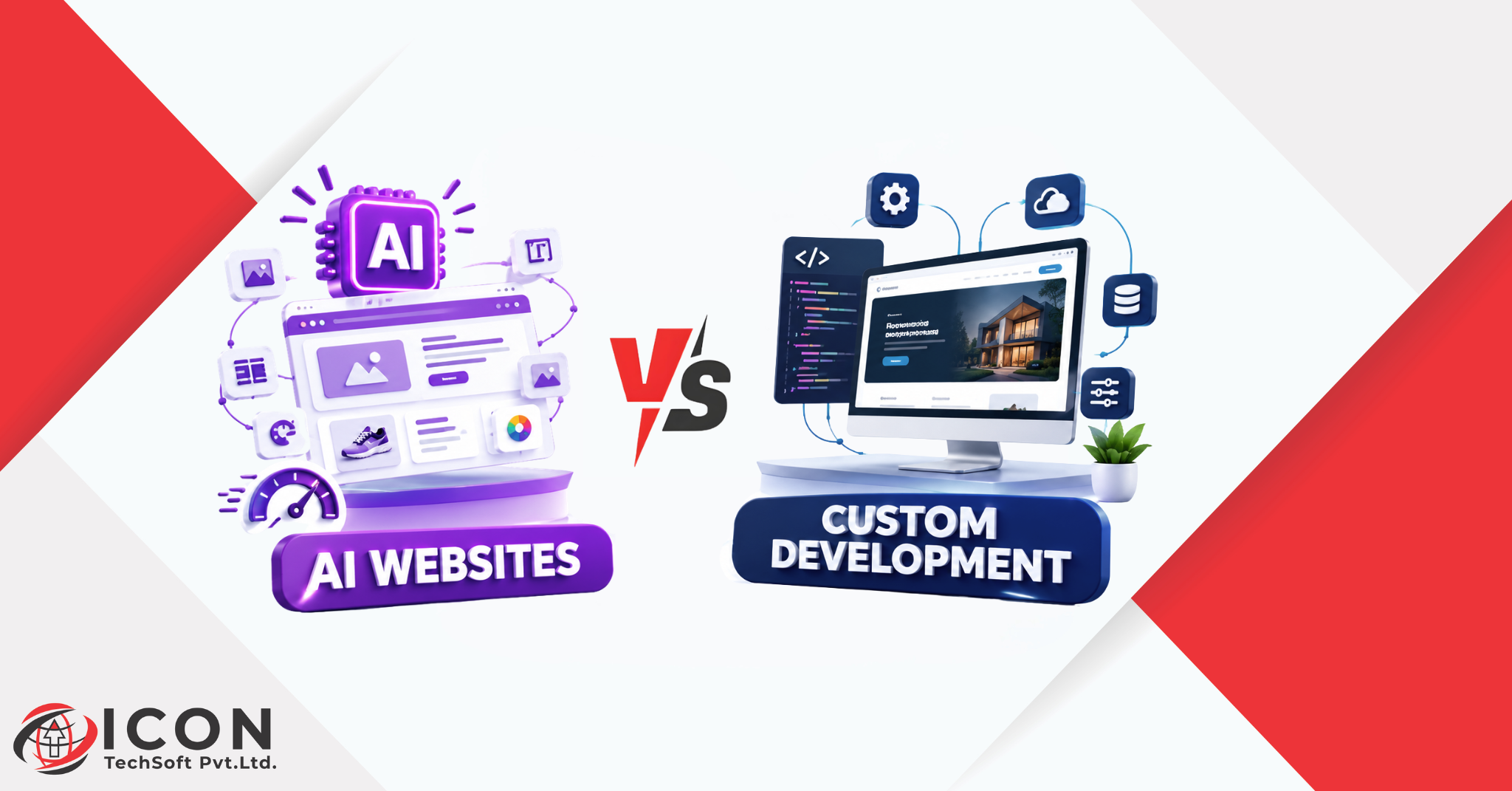
Building a website no longer requires every business to start with a designer and a developer. Today, business owners can describe their ideas to an AI tool and receive a website layout, suggested content, and design elements in a short time. This has made launching an online business easier, especially for people who have limited budgets or little technical experience.
However, creating a website and creating the right website are two different things.
Consider a small consultancy that wants to introduce its services online. It needs a homepage, a few service descriptions, information about the team, and a contact form. An AI website builder could be enough to get the business started.
Now consider a company that wants customers to create accounts, request quotations, track orders, and receive updates through its website. It may also need connections with its CRM and accounting software. Such a project requires more planning and technical control.
This is why the discussion around AI Website vs custom development deserves more than a simple comparison of price and speed. The better choice depends on how the website will support the business today and what it may need to do in the future.
An AI-powered platform can reduce the effort involved in creating standard pages. Custom web development allows a team to design the website around specific workflows, customer expectations, and business requirements.
Both approaches have their place. In this guide, we will examine their practical differences, explore popular website-building tools, and explain how to choose a solution that fits your goals without spending money on features you do not need.
AI Websites are websites created with assistance from artificial intelligence. Instead of manually designing every page, users provide information about their business and let the tool generate an initial version.
Depending on the platform, this may include page layouts, headings, written content, images, colour combinations, and navigation menus. Some tools also help with product descriptions, landing pages, and other website content.
For example, a local interior design business could ask an AI tool to create a website featuring its services, project gallery, customer testimonials, and enquiry form. The tool might generate a starting layout with sections relevant to that industry.
The business owner can then change the wording, replace sample images, add genuine project photographs, and adjust the design.
The important point is that AI creates a starting point rather than guaranteeing a finished product. The business still needs to check whether the website accurately represents its services and gives visitors the information they need.
Most AI website builders follow a similar process, although their features and capabilities vary.
First, you describe your requirements. You explain the type of business, the purpose of the website, your audience, and the features you want.
Next, the platform creates a structure. It suggests relevant pages and sections based on your instructions. A restaurant might receive a menu page and reservation section, while a consulting firm might receive service pages and a contact form.
The tool then generates a design. This can include typography, colours, images, buttons, and page layouts. Some platforms provide several options that you can adjust.
You review and improve the content. AI may suggest headlines, service descriptions, and calls to action. These should be checked for accuracy, tone, and relevance before publication.
Finally, you prepare the website for launch. You connect your domain, configure available settings, test the pages, and publish the finished version.
This process reduces the amount of manual work involved in getting started. However, the quality of the final website still depends on the instructions you provide and the improvements you make afterward.
One major advantage is accessibility. Someone without coding knowledge can create a basic online presence and manage routine changes independently.
AI can also speed up early decisions. Rather than starting with a blank page, users can review a suggested layout and decide what needs to change.
Other advantages include:
These benefits are useful, but they do not remove every challenge.
A generated website may contain generic wording that does not explain what makes a business different. Its layout may look attractive but fail to guide visitors toward the right action. The platform may also restrict advanced integrations or custom functionality.
There is another consideration: dependence on the provider. If the business later wants to move to a different system, transferring its content, design, or functionality may take additional work.
AI-generated websites work best when their limitations are understood from the beginning. They are practical tools for reducing routine work, not automatic replacements for planning, quality checks, and technical expertise.
Custom web development involves creating a website according to the requirements of a particular business. The team plans the design, functionality, and technical structure around the intended users and business objectives.
This does not mean every component must be written from scratch. Developers can use existing frameworks, content management systems, libraries, and third-party services. The difference is that the solution is deliberately assembled and adapted to meet the project’s needs.
Imagine an online retailer that sells products across several regions. It may require different pricing rules, customer accounts, inventory updates, payment options, and delivery calculations. A developer can design how these features work together rather than relying entirely on the options available in a standard template.
Custom development is also useful when a business wants a distinctive customer experience or needs its website to connect with internal systems.
A well-managed project begins with understanding the problem, not immediately writing code.
1. Requirement analysis
The team discusses the business goals, target audience, essential pages, expected traffic, and required features. It also identifies any existing systems that the website must connect with.
2. Website planning
The team decides how information will be organised and how visitors will move through the website. Technical decisions may include the database, hosting environment, frameworks, and integration methods.
3. UI/UX design
Designers create wireframes and visual concepts before development begins. They consider readability, navigation, accessibility, mobile layouts, and the steps users need to complete a task.
4. Development
Developers build the interface and implement the required functionality. Depending on the project, this may include account management, booking systems, payment processing, dashboards, or connections to other business software.
5. Testing
The team checks the website across relevant browsers and devices. Forms, navigation, integrations, performance, and security controls are tested before launch.
6. Launch and ongoing support
Once approved, the website is published. Maintenance may include software updates, backups, monitoring, bug fixes, and improvements based on customer feedback.
This process requires more coordination than generating a basic website with AI. In return, it gives the business greater control over how the final solution works.
The biggest benefit is the ability to build around real requirements instead of changing business processes to fit a tool.
Custom website design can help a company establish a distinctive visual identity, improve the customer journey, and create features that standard templates do not support.
It also makes it possible to plan integrations with systems such as CRM platforms, ERP software, payment providers, and inventory tools.
For example, a service company might want customers to submit an enquiry, receive an estimate, approve the quotation, and track the job through one connected process. A custom solution can be designed around those steps.
Other benefits include greater control over technical architecture, more freedom to introduce new features, and the ability to optimise specific parts of the website.
However, custom development requires a clear plan and suitable expertise. A poorly designed custom website can still be slow, difficult to maintain, or unnecessarily expensive. The quality of the outcome depends on the team and the decisions made during the project.
The main difference is not simply who writes the code. It is how much control the business needs over the website’s design, functionality, and future development.
A standard website builder may handle common requirements efficiently. A custom project becomes more useful when those requirements no longer fit the available tools.
An AI website builder generally costs less to get started with. Many platforms offer subscription plans that include a visual editor, hosting, and selected features. Some also offer free plans with restrictions.
Custom development involves more work before the website can launch. Costs may include planning, design, development, testing, deployment, and ongoing technical support.
However, comparing only the initial price can lead to the wrong decision.
Suppose a small business needs five pages and a contact form. Paying for a complex custom solution may provide little practical benefit when a standard builder already meets its needs.
Now consider a company that needs several software integrations and a specialised ordering process. A low-cost builder may not support those requirements without additional tools, workarounds, or development expenses.
When comparing options, consider the total cost of ownership:
The practical choice: Start with an AI builder when the requirements are simple and predictable. Consider custom development when additional control can solve a real business problem or prevent costly limitations later.
AI tools can generate an initial layout much faster than a traditional project can move through planning, design, and development.
This can be particularly helpful when a business needs a simple landing page or wants to establish an online presence quickly.
However, a generated layout is not the same as a website that is ready for customers. Content must be reviewed, images selected, links checked, and forms tested. SEO settings and domain configuration also need attention.
Custom development takes longer when requirements are complex. A basic website may be relatively quick to build, but a platform with multiple integrations and user-specific features needs more planning and testing.
The useful comparison is therefore not just how quickly the first version appears, but how quickly the business can launch a reliable website that meets its requirements.
Website design affects more than appearance. It influences how visitors understand a business and whether they can find the information they need.
AI website builders usually provide editable layouts, templates, colours, fonts, and page sections. This is often sufficient for a business website with standard requirements.
The difficulty arises when the business wants a design or interaction that the platform does not support. Some builders restrict access to underlying code or limit changes to specific components.
Custom development gives designers and developers more freedom to create specialised layouts, interactive experiences, and carefully planned customer journeys.
For example, a consultancy may need a clean services page, while a manufacturer may need an interactive product configurator that lets customers select specifications and request a quotation.
The first requirement is relatively straightforward. The second may require functionality that a standard builder cannot provide effectively.
Neither AI-generated websites nor custom-developed websites automatically rank well in search engines.
SEO depends on several factors, including content quality, technical accessibility, site structure, mobile usability, and the relevance of the pages to what people are searching for.
Many AI website builders provide basic SEO controls. Users may be able to edit page titles, meta descriptions, URLs, and image alt text. Some platforms also generate XML sitemaps or provide tools for managing redirects.
These features can be sufficient for a small business website.
Custom development provides more control over technical elements, but that advantage only matters when it is used correctly. Developers must still implement appropriate page structures, metadata, redirects, structured data, and performance improvements.
For either approach, businesses should:
AI can assist with SEO research and drafting, but automatically generated text should not be published without review. Content needs to be accurate, relevant, and useful to the intended audience.
For example, a web development company should explain its services, working process, expertise, and project outcomes rather than filling every page with repeated variations of the same keyword.
The practical choice: Both approaches can support effective SEO. Custom development offers more technical flexibility, while a capable website builder may be sufficient for a business with straightforward requirements.
Visitors expect websites to respond smoothly, work on mobile devices, and make important information easy to find.
A website builder may provide managed hosting and standard layouts, reducing some technical work. However, performance still depends on the platform, images, scripts, and features used.
Custom development allows the team to make more specific decisions about code, caching, image delivery, and hosting. These choices can help improve performance when implemented properly.
Still, custom code is not automatically faster. Unnecessary scripts, oversized images, and poor technical decisions can slow down any website.
User experience is equally important. A website should help visitors complete their intended task without unnecessary confusion.
An ecommerce website, for instance, needs clear product information, useful filters, a straightforward basket, and a reliable checkout process. A professional services website should make its expertise, services, and contact options easy to find.
The practical choice: A well-configured builder can provide a good experience for standard websites. Custom development becomes more valuable when the website requires specialised interactions or more precise performance control.
Security deserves attention regardless of how a website is built.
Many website builders manage hosting infrastructure, SSL certificates, and certain updates. This reduces the amount of technical maintenance required from the business owner, although the actual protections vary by provider.
Custom development allows security measures to be designed around the website’s specific needs. These may include access controls, secure authentication, input validation, monitoring, and data protection procedures.
However, greater control also means greater responsibility. Vulnerable dependencies, weak access controls, and poor server configuration can create risks in a custom-built website.
Before choosing either approach, consider what information the website collects, where it is stored, who can access it, and how it will be protected.
Businesses should also understand their responsibilities under applicable privacy and data protection laws.
The practical choice: A managed builder can be convenient for a straightforward website. A custom solution may be preferable when specific security controls or data-handling requirements cannot be met through the available platform.
A website that meets today’s requirements may need to do much more in the future.
A small company might begin with service pages and a contact form, then add a blog, online bookings, customer accounts, or ecommerce functionality.
AI website builders can support this kind of growth when the required features are available. The difficulty arises when the business needs functionality beyond the platform’s limits.
Custom development allows the technical structure to be planned around expected changes. Developers can create reusable components and integrate systems that support the company’s future operations.
However, a custom website also needs maintenance. Updates, backups, security monitoring, and bug fixes require time and resources.
Before deciding, consider how likely your requirements are to change. If you expect to introduce several new systems or build complex features, flexibility may be worth the additional investment.
If the website will remain relatively simple, a managed platform may be easier and less expensive to maintain.
| Factor | AI Websites | Custom Development |
|---|---|---|
| Initial investment | Usually lower | Usually higher |
| Basic website launch | Often faster | Depends on project scope |
| Design control | Depends on the platform | Greater flexibility |
| SEO | Depends on available tools | Greater technical control |
| Performance | Depends on platform and implementation | Can be tailored to specific needs |
| Security | Some infrastructure is managed by the provider | Controls can be tailored to requirements |
| Integrations | Depends on supported tools | Can support specialised integrations |
| Future growth | Depends on platform limitations | Can be planned around business needs |
| Maintenance | Often simpler for routine tasks | May require specialist support |
The comparison should help you identify which trade-offs matter most to your business. There is no need to pay for custom development if your requirements are already covered by a reliable builder.
Different platforms serve different purposes. Before choosing one, consider whether you need a marketing website, an online store, a portfolio, or a more specialised business solution.
Wix AI
Wix combines AI-assisted website creation with a visual editor and a range of business features. It may suit companies that want to create service pages, manage content, and add supported business functionality without handling much code.
Hostinger Website Builder
Hostinger offers website-building tools with AI-assisted creation and content features. It may be worth considering for startups and small businesses that want a relatively straightforward setup.
Squarespace
Squarespace focuses on visual design and provides tools for building professional websites. It may suit creative businesses, consultants, portfolios, and selected ecommerce projects.
Shopify
Shopify is primarily designed for ecommerce. Its store management features make it relevant to businesses that want to sell products, manage orders, and work with supported ecommerce integrations.
Framer
Framer combines visual website design with AI-assisted creation features. It may suit designers, startups, and businesses that need modern marketing websites or landing pages.
These platforms are not direct replacements for one another. Their features, pricing, export options, and integration capabilities differ.
Before committing, check whether the platform supports your required features and whether you can move your content if your needs change. The best AI website builder is the one that fits your project rather than the one with the longest feature list.
For many small businesses, the first website needs to answer a few simple questions: What does the company offer? Who does it serve? Why should customers trust it? How can people get in touch?
A website builder for small business can address these needs without requiring a large development budget.
Consider a local home maintenance company. It may need separate pages for plumbing, electrical repairs, cleaning, and maintenance, along with service-area information and an enquiry form. A suitable builder could provide everything needed to launch.
The business owner could then update service descriptions, add customer reviews, and publish new pages as the company grows.
The situation changes when the website becomes part of the company’s daily operations. If customers need to track jobs, receive personalised quotations, or access an account dashboard, the existing platform may not be enough.
Before choosing a builder, ask yourself:
For a business with standard requirements, AI can be a sensible starting point. If the website must support complex workflows, compare the cost of custom development before making a long-term commitment.
Learning how to build a website with AI starts with understanding what the website needs to accomplish. The tool can help generate pages, but it cannot replace every business decision.
Identify the main goal. You may want to generate enquiries, sell products, accept appointments, or introduce your services.
This decision helps determine which pages and features are necessary.
Think about what visitors need to know before contacting or buying from you.
A business serving corporate clients may need case studies and detailed service information. A local service provider may need pricing guidance, service-area details, and a simple contact form.
Compare website builders based on cost, design options, SEO settings, integrations, and ease of use.
Make sure the platform supports your essential requirements rather than relying on features that may be available only through expensive upgrades.
Give the AI tool clear information about your business, audience, preferred style, required pages, and desired features.
For example, a digital services company might request a homepage, service pages, portfolio, blog, and contact page, with a clean layout and clear enquiry buttons.
The more specific your instructions, the easier it becomes to evaluate the generated result.
Check whether the design reflects your brand and whether the content accurately describes your business.
Replace generic text, remove placeholder information, and use images that are relevant to your services. Make sure each page has a clear purpose.
Configure contact forms, booking tools, product listings, payment options, or integrations as needed.
Avoid adding features simply because they are available. Every additional tool should serve a clear purpose.
Write appropriate page titles and meta descriptions, organise headings, add meaningful image alt text, and check internal links.
Verify that important pages can be crawled and indexed. Also check the mobile layout, page speed, and secure connection.
Submit test enquiries, check buttons, open pages on different devices, and correct any errors.
Review the website from a customer’s perspective. If important information is difficult to find, improve the layout before launch.
Use analytics to understand how people interact with the website and Google Search Console to monitor indexing and search performance.
Update content when business information changes, and improve pages based on real customer needs.
A successful AI-generated website requires more than a good prompt. The review, testing, and improvement stages are what turn an initial design into a useful business asset.
AI-powered website creation is worth considering when your requirements are clear and do not involve complex technical features.
It may be suitable if you are launching a startup, creating a portfolio, testing a new service, or building a basic company website.
It can also help when your team wants to manage everyday changes without contacting a developer for every small update.
For example, a consultant who needs a homepage, service descriptions, a blog, and a booking link may not need a custom-built platform. A builder could provide a practical solution at a lower initial cost.
AI is particularly useful when:
However, make sure the platform offers enough flexibility for your likely next steps. A quick launch is useful only if the website can continue meeting your needs.
Custom development becomes more relevant when standard website features cannot support the way your business operates.
A company may need advanced booking rules, user-specific dashboards, specialised pricing, automated workflows, or integrations with several business systems.
For example, a distributor may need its website to display customer-specific prices, check stock availability, and send orders directly to its inventory system. These requirements involve more than displaying information on a page.
Custom development may also be appropriate when the website needs a distinctive user experience or must meet particular technical and security requirements.
Consider it when:
The investment should be justified by a real business need. If a standard platform can perform the required tasks reliably, custom development may introduce unnecessary cost and maintenance.
The decision becomes easier when you start with the website’s purpose instead of the technology.
If you need a simple online presence, an AI website builder may provide the best balance of cost, speed, and convenience. If your website must perform complex tasks or connect several systems, custom development deserves closer consideration.
A hybrid solution may also work. You could use a builder for marketing pages and add professional development for a specialised feature. Alternatively, AI could assist with initial design concepts while a development team creates the final website.
Before choosing, compare three things.
Your current needs: List the features that are essential at launch. Separate them from ideas that can wait.
Your future plans: Consider whether you expect to add new services, markets, integrations, or customer features.
Your total investment: Include ongoing subscriptions, maintenance, premium tools, and the cost of making changes later.
Avoid selecting a solution simply because it is the cheapest or most advanced. A good decision balances the website’s requirements with the resources available to build and maintain it.
Are AI-built websites good for business?
Yes. They can work well for companies that need a professional online presence with standard features such as service pages, contact forms, blogs, or selected ecommerce functions. Their effectiveness depends on the quality of the content, design, platform, and ongoing management.
Can AI website builders create SEO-friendly websites?
Yes. Many builders offer basic SEO settings, including page titles, meta descriptions, and image alt text. Some also support sitemaps and other technical features. However, good rankings still depend on useful content, accessibility, site structure, and other SEO factors.
Are AI website cheaper than custom-developed websites?
They usually cost less initially because the platform handles much of the setup. However, subscriptions, premium features, integrations, and future migration can increase the total cost. Custom development has a higher initial investment but may be worthwhile for specialised requirements.
Can an AI website be customised after it is generated?
Yes. Most builders allow users to edit text, images, colours, fonts, and page sections. Some support integrations or custom code. The amount of control depends on the platform and its plan.
Can a business website built with AI scale as the company grows?
Yes, provided the platform supports the additional pages, traffic, and features the business needs. More complex requirements may eventually require a different platform or custom development. Check the platform’s limitations before committing.
Is custom web development still worth the investment?
Yes, when a business needs specialised functionality, deeper integrations, or greater technical control. It can provide long-term value when those capabilities support important operations. For a simple website, however, a standard builder may be more practical.
Choosing between AI Website and custom development starts with understanding what your business actually needs from its website.
For a small business that wants to introduce its services, publish useful information, and collect enquiries, an AI website builder may be enough. It can reduce the initial workload and make routine updates easier.
A business with complex ordering, specialised integrations, or customer-specific functionality may benefit more from custom development. In that situation, greater control over the website’s structure and behaviour can justify the additional investment.
There is also room between these two approaches. AI can help with initial layouts and content drafts, while experienced developers handle the parts that require technical knowledge or greater flexibility.
Before making your choice, list your essential features, estimate your budget, and consider how the website may change as the company grows. Review ongoing costs and platform limitations rather than focusing only on how quickly the first version can be created.
The right website is the one that meets your customers’ needs, supports your business goals, and remains practical to manage over time. Whether you choose an AI-powered builder or a custom solution, careful planning and regular improvement will make a greater difference than the technology alone.