-
Gujarat, India
- info@icontechnology.in
- 24/7 Customer Support
Gujarat, India
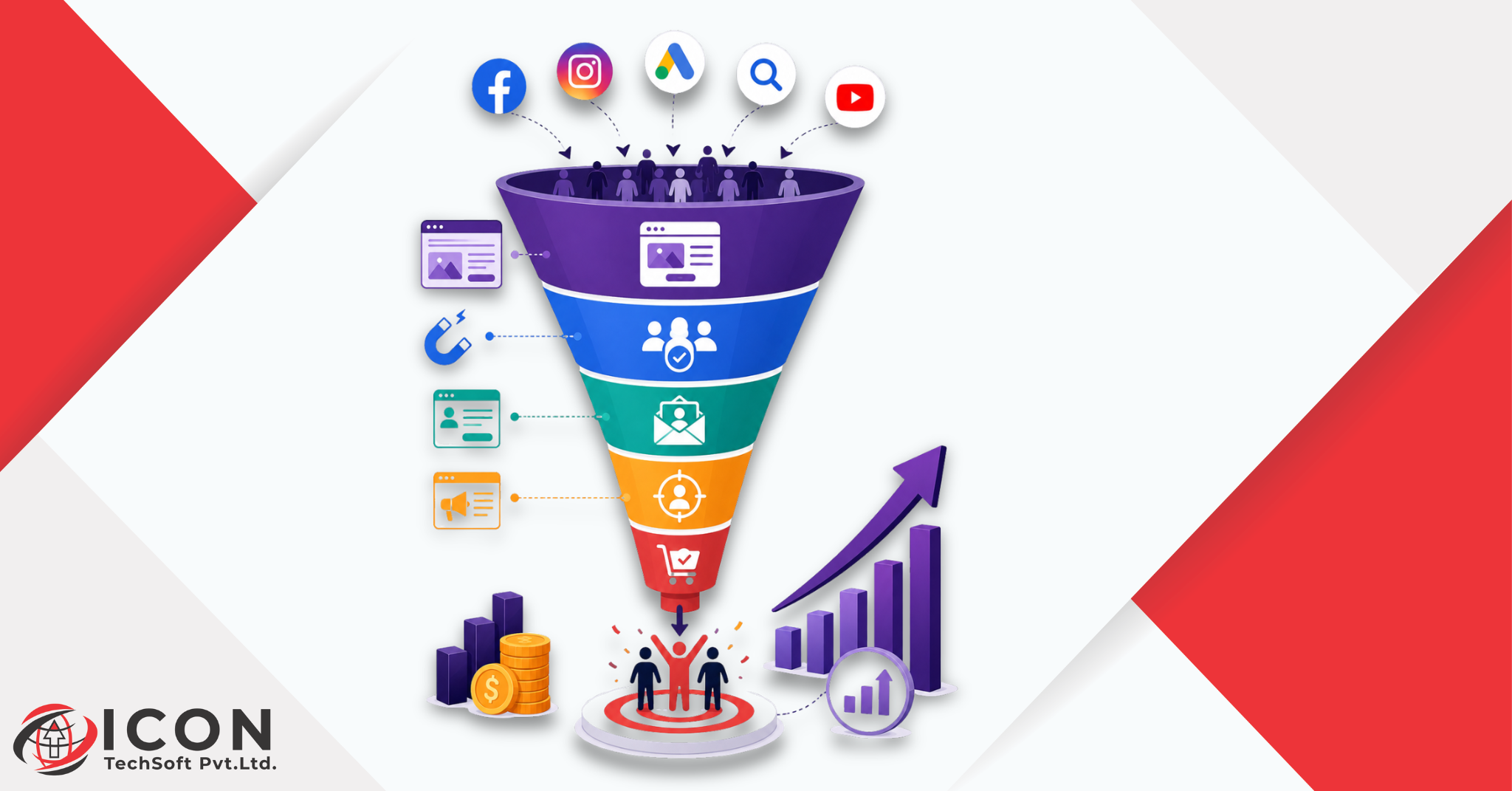
Here’s the honest truth: most businesses spend money on ads without really knowing why some campaigns work and others quietly burn through budget. A performance marketing funnel is what fixes that. It’s a step-by-step path that takes someone from “never heard of this brand” to “just bought from this brand,” and ideally, to “bought again.”
What makes it different from regular marketing is that nothing is left to guesswork. Every click can be traced. Every lead has a source. Every sale can be tied back to the exact campaign that caused it. That’s the whole point of performance marketing, and it’s why the funnel matters so much.
A funnel, in simple terms, connects everything a business does online, ads, blog posts, emails, landing pages, into one journey instead of a pile of unrelated activities. Rather than throwing campaigns at the wall, you’re mapping out how a total stranger turns into a lead, then a customer, and hopefully someone who keeps coming back.
Old-school marketing was built around visibility. Think of a billboard on the highway or a 30-second TV spot. Millions of people might see it, but good luck figuring out how many of them actually bought something because of it.
Performance marketing flips that. Every single campaign has a defined goal attached, a click, a form fill, a sale, and every rupee spent can be traced to a result. That’s really why so many businesses have shifted their budgets toward it. It replaces guesswork with actual numbers.
Picture the funnel as the glue between what marketing does and what the business actually gets out of it. A blog post pulls in a curious visitor. An email nudges that visitor toward becoming a lead. A retargeting ad finally closes the deal. None of these things do much on their own, honestly. It’s the funnel that stitches them together into something that keeps producing conversions month after month.
Skip the funnel, and marketing turns into a bunch of disconnected campaigns running in parallel with no real strategy tying them together. A funnel forces you to think about the entire journey a customer takes, not just that first ad they clicked. And that shift, thinking end-to-end instead of campaign-by-campaign, is usually what separates businesses with steady growth from ones that are constantly starting from zero.
At its core, a performance marketing funnel works by getting the right message in front of the right person at the right moment in their buying journey. Not everyone who lands on your site is ready to whip out their credit card. Treating a first-time visitor the same as someone who’s been comparing options for two weeks is one of the fastest ways to waste ad spend.
There are four stages that make up pretty much every performance marketing funnel: awareness, consideration, conversion, and retention. Awareness gets a brand in front of new eyes. Consideration is where trust gets built. Conversion is the actual sale. And retention, well, that’s what keeps a customer from being a one-time buyer. Each stage needs its own tone, its own content, its own type of ad. Using the same message across all four rarely works.
Here’s something worth knowing: people don’t move through a funnel in a straight line, ever. Someone sees an Instagram ad, checks out the site, gets distracted, leaves. A week later they Google the product again, land on the blog, and eventually convert after seeing a retargeting ad on Facebook. That messy back-and-forth is completely normal. A funnel that’s built well keeps nudging that person forward no matter how many times they wander off.
Paid ads are honestly one of the quickest levers to pull if you want to move people through the funnel faster. At the top, they introduce the brand to people who’ve never heard of it. In the middle, they reinforce why the brand is worth considering. And near the bottom, they give warm leads that final push to actually buy. Pull ads out of any one of these stages and the whole funnel tends to slow down.
This is where people first bump into a brand, usually without even looking for it. The point isn’t to sell anything yet, it’s to get in front of the right kind of person. Social media ads, SEO content, and influencer shoutouts are the usual tools here, and the aim is reach that’s still relevant, not just reach for the sake of numbers.
Once someone’s aware a brand exists, the next job is earning their trust. Blog posts, case studies, side-by-side comparisons, testimonials, email newsletters, this is the stage where all of that lives. You’re basically answering the questions people haven’t asked out loud yet and showing them why you’re a better pick than the other five tabs they’ve got open.
This is the stage the funnel is named after, really. Landing pages, offers, and calls to action all come together here to get someone to finally take the step, buy the product, book the call, sign up for the trial. If awareness and consideration did their job, conversion is often the easiest part.
A lot of businesses stop thinking about the funnel the moment a sale happens. Big mistake. Retention is where email marketing, loyalty perks, and personalized offers keep a customer engaged long after checkout. And since keeping an existing customer costs a fraction of acquiring a new one, this stage quietly does a lot of heavy lifting for long-term profit.
Building one from the ground up isn’t complicated, but skipping a step usually shows up later as weak results.
That’s really the backbone of any performance marketing funnel strategy, whether you’re running a two-person local shop or a full-scale e-commerce brand.
Ads don’t do the same job at every point in the digital marketing funnel, and treating them like they do is a common mistake.
These exist purely to put the brand in front of a cold audience. Video content, strong visuals, broader targeting, that’s what tends to work here since the goal is recognition, not an instant sale.
Now it’s about product benefits, real customer reviews, maybe a free guide or webinar. You’re keeping the brand in someone’s head while they’re out there comparing options.
These talk to people who already get it and are close to deciding. Clear offers, a countdown on a discount, a strong CTA, this is where that kind of urgency actually pays off.
Shown to people who already visited but didn’t buy. Honestly, retargeting often brings in some of the best returns of any ad type simply because the audience already knows who you are.
Every platform lets you pick an objective, traffic, engagement, leads, conversions. Matching that objective to where someone is in the funnel matters more than people think, because the algorithm optimizes for whatever goal you set, even if it’s the wrong one for that audience.
Running ads is the easy part. A real performance marketing funnel strategy pays attention to the smaller details that decide whether someone actually converts or bounces.
An offer built for someone who just discovered your brand rarely works on someone who’s ready to buy right now, and vice versa. Getting this match right is one of the simplest ways to lift conversions without spending more.
Generic messaging tends to fall flat. When content and offers reflect someone’s actual behavior, location, or past interactions, it feels less like an ad and more like something relevant, and that alone tends to move the needle.
Most people won’t buy on their first visit, not even close. A solid retargeting setup brings them back with a reminder, some social proof, or a slightly better offer than before.
“Get a Free Quote” beats “Click Here” every time. Being specific about what happens next removes the hesitation that kills conversions.
Long forms, slow pages, confusing menus, pricing that’s hidden three clicks deep, all of it adds friction. Fixing these often lifts conversion rates more than any amount of extra ad spend.
When the ad, the landing page, and the actual offer all say the same thing, trust builds naturally. The moment there’s a gap between what the ad promised and what the page delivers, people leave, fast.
This is often where a performance marketing funnel either closes the deal or quietly loses it.
Focused, clear, no clutter. It answers the visitor’s biggest question right away, spells out the benefit, and makes the next step obvious without them having to hunt for it.
If the ad says 20% off, the landing page better say 20% off the second someone lands there. That consistency, called message matching, does more for trust than any design tweak.
Sending ad traffic to a generic homepage instead of a dedicated page. Cluttering the page with links that pull attention away from the offer. Asking for way more information than necessary before someone’s even decided to trust you. All small things, all quietly expensive.
This is really what sets performance marketing apart from the old billboard-and-hope approach. Without solid metrics, there’s no way to know what’s actually working.
None of these tell the full story alone. Looking at them together is what actually shows how the funnel is performing.
Optimization isn’t a task you finish and check off. It’s ongoing.
Even a well-funded campaign can flop if these basics get ignored.
Let’s put this into a real-world scenario.
Say a skincare brand wants to reach working professionals, roughly 25 to 40 years old, who care about natural ingredients.
Short video ads on Instagram and Facebook show off the natural ingredients and results, aimed at a broad but still relevant audience.
Visitors who didn’t buy get shown testimonial-heavy ads and before-and-after photos, alongside a blog post digging into the science behind the formula.
Anyone who added something to their cart but bailed before checkout sees a limited-time discount ad, paired with a simplified, faster landing page.
Past buyers get shown a complementary product, nudging them toward a second purchase and boosting lifetime value.
CTR, CPL, conversion rate, and ROAS get tracked at every stage, which tells the brand exactly which campaigns are actually making money and where the budget should shift next.
A performance marketing funnel works best when it’s not operating in isolation.
Organic traffic from SEO content can flow into the same funnel used for paid ads, which lightens the load on ad spend over time.
Organic social builds community and familiarity. Paid social speeds up reach and conversions. Together they cover each other’s weak spots.
Email is still one of the cheapest, most effective ways to nurture leads through consideration and bring past customers back during retention.
When SEO, social, email, and ads all say the same thing in a consistent voice, the whole journey feels seamless, and that consistency is what builds trust.
Improving a funnel mostly comes down to spotting the weak points and doubling down on what’s already working.
Look at exactly where people are leaving, the landing page, checkout, a form, and fix that specific spot instead of guessing at the whole funnel.
Once the data’s clear on what’s converting best, shift more budget there. Simple, but often skipped.
Pouring more money into ads before fixing conversion issues just means paying more to expose the same weak spots. Fix the funnel first.
Email follow-ups, audience updates for retargeting, weekly reporting, automate what you can so there’s more time left for actual strategy.
A funnel is never really “done.” Behavior shifts, platforms change their algorithms, and what worked last quarter might not work this one. Keep testing.
A funnel, done right, turns a pile of scattered marketing efforts into one connected system that keeps producing conversions. Understand the stages, use ads with intention at each one, build landing pages that actually deliver on what the ad promised, and keep an eye on the right metrics. Do that consistently, and traffic stops being just traffic, it starts turning into real, recurring revenue.