-
Gujarat, India
- info@icontechnology.in
- 24/7 Customer Support
Gujarat, India
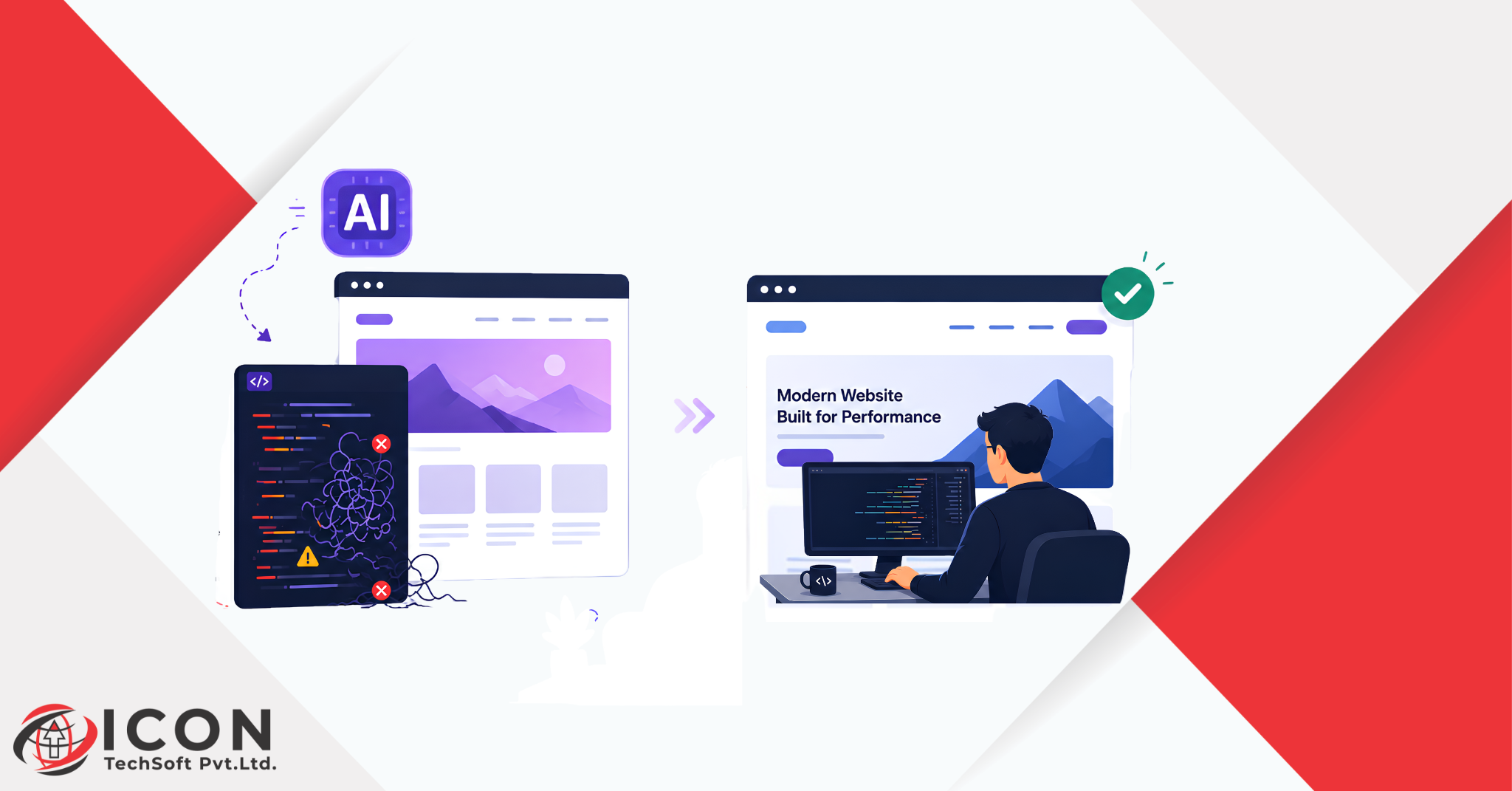
Spend five minutes in a developer Slack channel or scrolling tech Twitter (X, whatever we’re calling it these days) and you’ll run into the term “vibe coding” sooner or later. It sounds like a joke at first. It isn’t.
Vibe coding describes something that’s actually happening across thousands of projects right now: building websites, apps, and features by telling an AI what you want in plain English, then letting it write the code. No manually typing out every function. No line-by-line logic. You describe the “vibe”, a landing page, a signup flow, a dashboard, and tools like GitHub Copilot, Cursor, Claude, or Replit’s AI agent turn that description into working code.
The name stuck after AI researcher Andrej Karpathy casually described his own workflow in early 2025: accept whatever the AI suggests, run it, see what breaks, tell the AI to fix it, repeat. He admitted he barely looked at the actual code. That loose, trust-the-process approach is basically what everyone means when they say “vibe coding” today.
The loop is pretty simple once you’ve seen it a few times:
Notice there’s barely any hands-on coding in that loop. The person running the show is more of a creative director than a traditional engineer, steering, not building.
A handful of things lined up at once to make this go mainstream:
Put those together and you get exactly the kind of environment where solo founders, indie hackers, and small teams start relying on vibe coding as their default way of building.
Traditional web development is, frankly, slow on purpose. There’s a reason for that. It follows a process, requirements, architecture, coding standards, reviews, testing, deployment, because every one of those steps exists to prevent a specific kind of failure down the road.
Vibe coding skips most of that. There’s usually no formal architecture document. Code gets generated, poked at, adjusted, and shipped, often within the same afternoon. That’s fantastic for speed. It’s also exactly why the codebases it produces look nothing like what a seasoned dev team would hand over.
Keep that distinction in mind, because it’s really the whole story of this article. The thing that makes vibe coding fast is the same thing that makes it risky.
It’s tempting to write this off as a fad. The adoption numbers say otherwise. AI coding assistants are now built into nearly every major dev environment, and there are entire companies whose product is an AI-first coding platform. Here’s why this shift is sticking around.
Speed is the obvious win, and it’s not subtle. A responsive landing page, a contact form with validation, a basic checkout flow, work that used to eat up a few days can now come together in minutes.
Development teams have started using AI tools less as a replacement for their process and more as a way to kill the boring, repetitive parts of it. Nobody wants to hand-write form validation logic for the tenth time this quarter. Generate it, move on, spend your energy on the parts of the project that actually need a human brain.
Before this shift, turning an idea into something clickable meant you either knew how to code or you had a budget to hire someone who did. That’s changed. A founder can now describe a product and have a working prototype the same day, not a static mockup, an actual functioning thing they can click through.
For a startup, that’s a big deal. Being able to show investors or early users something real instead of a Figma file can be the difference between capturing interest and getting lost in the noise, especially in a crowded market like India’s IT and SaaS space.
Even seasoned engineers work differently now. Instead of staring at a blank file, a lot of developers start with an AI-generated draft and shape it from there. That flips their day-to-day role, less “writer,” more “editor”, for a surprisingly large chunk of their work.
Code review is changing too. Teams are writing new guidelines specifically for reviewing AI output, because it doesn’t behave like human-written code. Sometimes it’s cleaner and more consistent than what a tired developer would write at 6pm. Other times it introduces a logic error a human simply wouldn’t make, the kind of subtle mistake that slips past a quick glance.
It’s not a universal solution, and it’s worth being honest about where it actually shines:
Where it falls apart is production-grade software with complex business logic, tight security requirements, or systems that need to hold up under real traffic. Which, not coincidentally, is exactly where traditional engineering discipline earns its keep.
AI-generated code isn’t a novelty act anymore. It’s part of the pipeline. Multiple industry surveys through 2025 found that a meaningful chunk of new code committed to repositories was fully or partially AI-written, and that number keeps climbing.
Modern coding tools run on large language models trained on huge amounts of public code, documentation, and Stack Overflow-style patterns. When you give one a prompt, it’s essentially predicting the most likely sequence of code that matches what you asked for, based on everything it’s seen before.
Some tools take it further. “Agentic” workflows don’t just spit out a snippet, they actually run commands, execute tests, read the error messages, and keep iterating on their own until things work. That’s the difference between something like basic autocomplete and a tool like Cursor or Claude Code, which feels more like handing work to a junior collaborator than typing into a fancy text box.
None of this is hype for hype’s sake. There are real upsides:
Here’s the part that gets glossed over: AI-generated code isn’t trustworthy just because it runs. A language model doesn’t “understand” your app the way an engineer who’s worked on it for six months does. It’s generating something statistically plausible, not something grounded in your actual business logic or security needs.
That gap is exactly where problems hide. Code can look completely fine, run without a single error, and still contain a slow database query, a security hole, or an accessibility gap that nobody notices until real users start hitting it. This is really where the “mess” in vibe coding starts to show itself.
This is the part of the conversation people tend to skip past, and it’s the part that actually costs businesses money and reputation if ignored.
AI-generated code tends to work fine in isolation but doesn’t naturally follow a consistent pattern as a project grows. Without someone enforcing structure, a codebase piles up what developers call technical debt, shortcuts and inconsistencies that make everything harder to touch later.
A landing page built through vibe coding might run perfectly today. Six months from now, when the business wants to add a new feature, a developer might open the project and find inconsistent naming, duplicated logic scattered everywhere, and zero explanation for why anything was built the way it was.
This is probably the scariest one. AI models learn from public repositories, and not all public code follows best security practices. Without a security-minded human checking the output, you can end up with:
If your business touches customer data, payment details, or login credentials, these aren’t minor annoyances. They’re the kind of gaps that lead to a breach and a very bad week.
AI tools are optimizing for “does this run,” not “does this run well.” That distinction matters. You end up with inefficient database queries, front-end components that re-render more than they need to, unoptimized images, and JavaScript bundles that are bigger than they should be. For a business relying on a fast site for SEO and conversions, that’s a real cost, not a technicality.
Accessibility is almost always an afterthought unless you specifically ask for it. Missing alt text, poor color contrast, non-semantic HTML, broken keyboard navigation, all common in AI-generated interfaces. Beyond the ethical problem of shutting out users with disabilities, this can turn into a legal liability depending on where your business operates.
Here’s the one that catches people off guard the most. Code built without any real architecture becomes exponentially harder to grow. Adding features, bringing on new developers, migrating frameworks, all of it gets significantly harder when the underlying codebase was never designed to be extended, just to work once.
Which brings us back to the question in the title. Vibe coding can build something fast. But when that something needs to grow, or hold up under real security scrutiny, who actually fixes it?
The answer is still human developers. What’s changed is what that job actually looks like now.
Developers are spending less time writing from scratch and more time reviewing, debugging, and cleaning up what the AI produced. That’s a genuinely different skill than writing code yourself. Reviewing AI output well means asking not just “does this run” but “is this secure, is this efficient, does this fit how the rest of the system is built.”
It’s a familiar pattern, honestly, the same thing happened in plenty of other industries once automation showed up. The human role climbs up the chain, from doing the work to making sure the work is right.
AI is genuinely good at generating individual pieces. It’s much weaker at understanding the big picture, how a database should be structured to support growth two years from now, which third-party services are actually worth integrating, how an API needs to be designed to support features that don’t exist yet. That kind of foresight comes from experience and business context, not pattern matching.
That’s why a lot of teams have settled into a split: let AI handle implementation, keep architecture and planning firmly in human hands.
Testing stops being optional the moment AI enters the picture, it becomes essential. Because AI code can look right while quietly hiding a bug, teams are leaning harder on automated tests, structured code review checklists, and staging environments where nothing goes live until it’s been properly stress-tested.
That means checking functionality (does it do what it’s supposed to), security (are there holes), performance (does it hold up under load), and accessibility (can everyone actually use it).
Not every project needs a full team behind it. But a few signals mean it’s time to bring in real developers:
If any of those apply, treat vibe coding as your starting point, not your finish line.
This is the question everyone actually wants answered, and the honest version is: it’s changing what developers do, not eliminating the need for them.
AI tools can already handle a lot, front-end layouts, back-end boilerplate, basic API integrations, quick bug fixes, translating code from one language to another. For simple, well-defined tasks, AI is often just faster than a human typing it all out.
Where it falls short is anything requiring real context, designing a system that needs to scale, weighing trade-offs based on business priorities, catching a subtle security issue, or untangling a bug that spans five different parts of a system. And there’s a more basic issue too: AI can’t be held accountable. It can’t own a data breach or a failed launch the way a team or agency can.
Web development was never just about typing code. It’s about solving a business problem with technology, understanding what users actually need, turning vague goals into technical decisions, making judgment calls when the requirements aren’t clear. Those are human skills. AI speeds up the execution, but it doesn’t replace that layer of thinking.
The more useful way to frame this isn’t “AI versus developers.” It’s “developers using AI versus developers who aren’t.” The first group will almost certainly outpace the second, but both still need real human judgment to be trustworthy.
If you want the speed of vibe coding without the cleanup bill later, a few habits make a real difference.
Before generating anything, decide on the basics, folder structure, naming conventions, the core tech stack. Giving the AI a consistent framework to work inside cuts down significantly on the chaos that tends to build up otherwise.
Vague prompts get you vague, inconsistent results. Being specific, including security needs, performance expectations, accessibility standards, noticeably improves what comes back. Treat your prompt like a short spec, not a casual ask.
Don’t treat AI output as production-ready by default. Even a basic manual review, paired with whatever automated testing you can manage, catches most of the serious problems before they reach a real user.
Make these non-negotiable, especially for anything customer-facing. A simple habit, scan for exposed keys, check load times, run an accessibility check, saves a lot of pain later.
Even in a fast-moving, AI-assisted workflow, basic documentation and version control (Git, obviously) mean changes are tracked, mistakes can be undone, and whoever picks this project up next, human or AI, can actually understand why decisions were made.
Every sign points to yes. Just like nobody writes raw machine code by hand anymore, future developers may rarely hand-write boilerplate. Vibe coding, or some more disciplined version of it, is looking less like a trend and more like a permanent part of the toolkit.
As AI absorbs more of the implementation work, the skills that matter most are shifting, system design, security expertise, knowing how to actually work with AI tools well, and strong debugging instincts. Knowing how to prompt, guide, and correct an AI is becoming almost as important as knowing how to code in the first place.
The direction this is heading suggests developers will spend more of their time supervising and architecting AI-driven systems than typing code line by line. That’s not a demotion. If anything, it pushes the role toward something more strategic.
Vibe coding has genuinely changed what’s possible. Projects that used to take weeks to prototype now come together in an afternoon. People who couldn’t code a year ago are shipping real products. Teams are moving faster than they ever have.
But speed without someone watching creates risk. AI can write the code, it can’t take responsibility when something goes wrong. It won’t own a security breach, a failed launch, or a codebase that quietly collapses under its own weight six months later. That responsibility still sits with people.
The businesses getting the most out of vibe coding aren’t the ones using it blindly. They’re the ones pairing its speed with actual human expertise, treating AI as a genuinely useful collaborator that still needs guidance and a second set of eyes. AI can write the code. Who fixes it, who secures it, who owns what it becomes, that’s still very much a human job.
What is vibe coding?
Vibe coding is building software or websites mostly by describing what you want in plain language and letting an AI tool generate the code, with very little manual coding involved.
Is vibe coding useful for web development?
Yes, especially for prototypes, MVPs, landing pages, and internal tools where speed matters more than deep, complex architecture.
Is vibe coding replacing web developers?
Not really. It’s reshaping the job, less writing every line, more reviewing and architecting AI output, but human expertise is still essential for anything complex, secure, or built to scale.
What are the biggest risks of vibe coding?
Security vulnerabilities, technical debt from poor code structure, performance issues, accessibility gaps, and codebases that become genuinely hard to maintain or scale.
Can AI-generated code be trusted?
It’s a solid starting point, but it shouldn’t be trusted blindly. It needs human review and testing before it touches production, especially anything handling sensitive data.
How do developers fix AI-generated code?
By reviewing it closely for security and performance issues, testing it properly, cleaning up inconsistent logic, and making sure it actually fits the system it’s part of.
Is vibe coding suitable for beginners?
Yes, it’s a great entry point for beginners and non-developers building prototypes. Anything business-critical still benefits from professional oversight.
Will vibe coding become the future of web development?
It’s looking that way. AI will likely handle more of the implementation work while developers shift toward architecture, security, and higher-level oversight.