-
Gujarat, India
- info@icontechnology.in
- 24/7 Customer Support
Gujarat, India
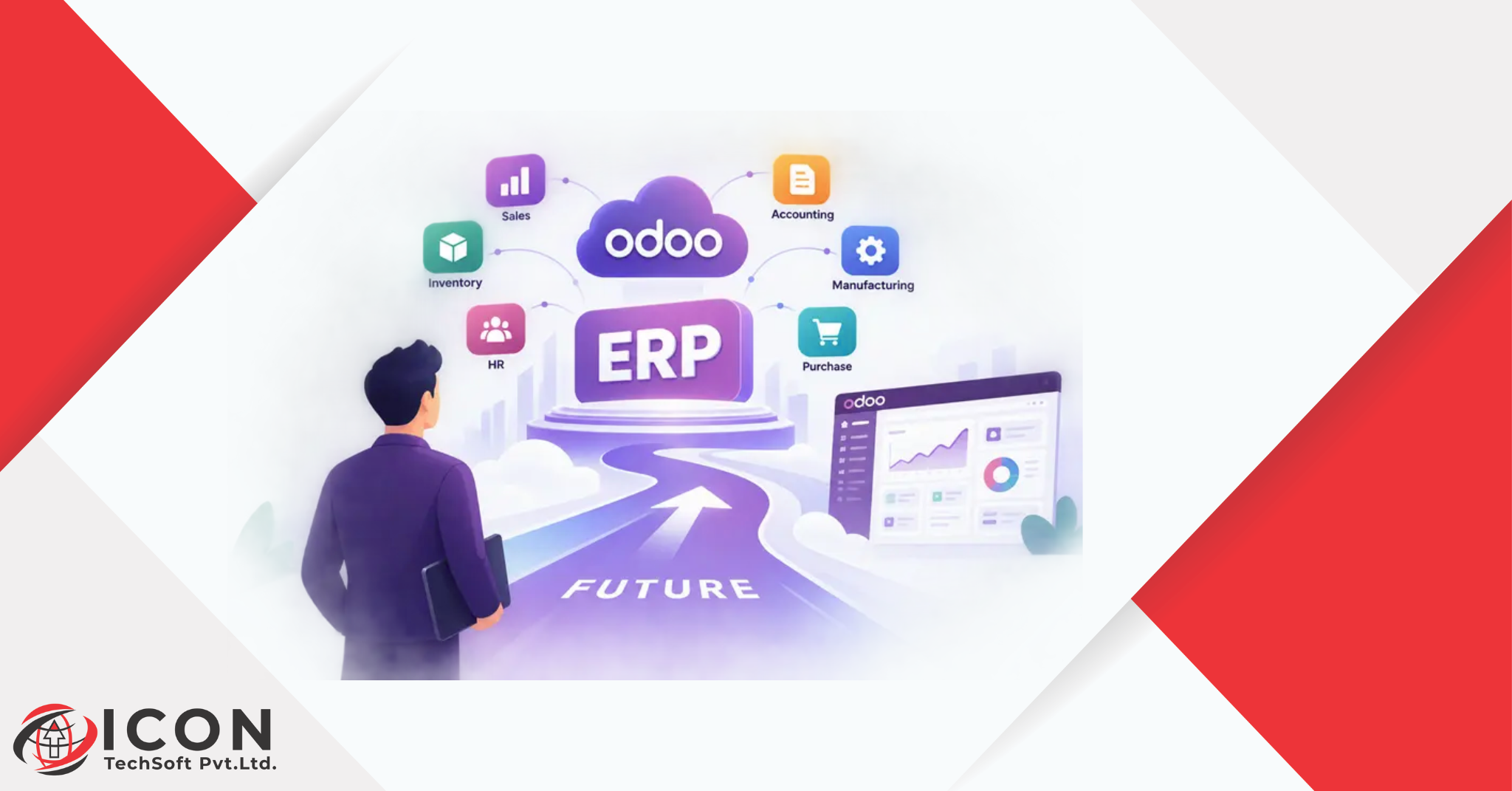
Ten years ago, running a business looked a lot simpler on paper, even if it didn’t feel that way at the time. Now customers want faster answers, teams are spread across cities (sometimes countries), and data has to move between departments without anyone chasing it down manually. That’s a big part of why the future of ERP keeps coming up in conversations with business owners lately. Nobody wants a stiff, one-size-fits-all system quietly slowing things down in the background anymore. They want something that can actually keep up.
That’s really the whole story behind why flexible ERP systems, Odoo being one of the more talked-about names, have picked up so much momentum. An ERP system used to mean something heavy. Expensive to buy, painful to install, and honestly a bit intimidating to learn. That picture is fading, and fast. What businesses want now is an erp solution that fits how they already operate, plugs into the tools they’re already using, and doesn’t quietly drain the budget every month.
So in this piece, we’ll get into what ERP actually means, how it’s changed, and why platforms like Odoo are the ones people keep pointing to when they talk about where this is all headed. If you’re running a small shop or managing something bigger that’s still growing, this should give you a clearer sense of what to expect from erp software going forward.
ERP is short for Enterprise Resource Planning, which sounds more complicated than it needs to be. In plain terms, it’s software that lets a business run its daily operations from one place instead of ten. Accounting, sales, inventory, HR, purchasing, customer relationships, all of it living under one roof rather than scattered across five different tools that barely talk to each other.
Here’s why that actually matters. Disconnected data creates chaos, plain and simple. Sales uses one tool, accounts uses another, and the warehouse team is still tracking stock on a spreadsheet somebody built three years ago. Orders slip through the cracks. Invoices go missing. Managers end up spending their afternoon trying to piece together a picture of the business that should have taken five minutes.
Good erp software fixes this. Every department is looking at the same live numbers. Make a sale, and inventory updates on its own. A payment comes in, and the books reflect it immediately, no double entry needed. That kind of connection saves time, cuts down on mistakes, and lets owners make calls based on what’s actually happening rather than a hunch.
And as companies grow, this need for one central system doesn’t shrink, it grows louder. Which is exactly why interest in modern erp system technology keeps climbing year after year.
Traditional ERP was built for a different era entirely. Big corporations, big budgets, dedicated IT departments on standby. Getting one installed could take months, sometimes years, and once it was in, changing anything meant a slow, costly project all over again.
Things look different now. Businesses of every size, not just the big players, need dependable software to keep operations running smoothly. That pressure has pushed the market toward flexible ERP solutions, ones that go live faster, adjust without drama, and scale without forcing a company to start from zero. This move from rigid to adaptable is arguably the biggest shift happening in ERP right now.
There’s also a real appetite for scalable erp software these days. A small business might only need basic accounting and inventory tracking today. Fast forward six months, add a new product line or a second location, and suddenly they need advanced reporting, multiple warehouses, and role-based access for a bigger team.
Older systems weren’t built to handle that kind of jump without a full overhaul. Newer platforms are designed with growth baked in from day one, so businesses can start small and add capability as they need it, without disrupting whatever’s already working.
No two businesses run the same way. A retail shop, a manufacturing floor, and a service company each have their own rhythm. Traditional ERP often forced businesses to bend their processes to fit the software, which never really made sense if you think about it.
Now it’s flipped. Businesses want the software to adjust to them, not the other way around. That’s a big reason adaptable, modular systems are becoming the default choice, and it explains why so many people are searching for why flexible ERP systems are the future of how companies get things done.
With a flexible ERP system, businesses only take on the features they’ll actually use. As the company grows, new modules slot in without breaking what’s already there. This kind of easy customization means nobody’s paying for tools gathering dust, and nobody’s stuck waiting months for an expensive redesign just to add one new feature.
Most businesses already run on a handful of tools, payment gateways, email marketing platforms, an online store maybe. A flexible erp solution connects with all of that instead of demanding a total switch. Existing workflows stay intact, and now they’ve got centralized data behind them too.
Traditional ERP setups often carried steep upfront costs plus ongoing fees that never seemed to stop. Flexible systems, particularly the open-source ones, tend to cost less to set up and keep running. That makes modern erp software something small and mid-sized businesses can actually afford, not just an option reserved for companies with a dedicated IT budget.
Priorities shift, that’s just business. Maybe a company enters a new market, adds a product line, or reworks how it manages stock. Flexible ERP systems roll with these changes instead of forcing a business to rebuild its entire tech stack every time something new comes up.
Older ERP systems had a reputation, and not a good one, for being clunky and hard to learn. The newer, flexible platforms put real thought into user experience: cleaner dashboards, mobile access, navigation that doesn’t need a training manual. Employees spend less time hunting for buttons and more time actually working.
Odoo works in modules rather than as one giant fixed block. There are separate apps for sales, accounting, inventory, HR, project management, and plenty more. A business can start with just one or two and build from there. That modular setup is a huge part of why Odoo stands out as a flexible erp solution in a crowded market.
Because Odoo is open-source, businesses get far more room to shape it around their own needs. A quirky invoicing format, a specific approval chain, some industry-specific process nobody else uses, Odoo can usually handle it without waiting on a vendor to release an update six months down the line.
One of the best things about Odoo is how tightly its apps work together. Sales, inventory, accounting, and CRM are all connected. A customer places an order, and stock levels update, an invoice gets generated, and the sales team knows about it, no manual data entry required.
Being open-source gives Odoo a kind of transparency that closed, proprietary systems just don’t offer. Businesses aren’t locked into one vendor’s timeline or roadmap. They can bring in implementation partners, customize as much as they want, and skip a lot of the licensing headaches that come standard with traditional erp system providers.
Odoo pulls sales, purchasing, inventory, accounting, HR, and customer support onto a single platform. That connection removes the need to juggle a pile of disconnected tools and gives owners a real, live view of what’s actually going on across the business.
Repetitive manual work is a drag on any team. Odoo is leaning further into automation for things like invoice generation, stock reordering, and following up with leads. As AI features keep expanding across the ERP world in general, Odoo is putting itself in a strong position as a system that actually helps teams work smarter instead of just harder.
Thanks to its modular build, Odoo lets businesses grow without the usual painful migration. A company might start with just accounting and inventory, then add HR, manufacturing, or e-commerce apps later, all inside the same platform they already know.
Retail, manufacturing, services, e-commerce, Odoo’s flexible structure bends to fit all of them. That adaptability is a huge part of how Odoo is shaping the future of ERP, since fewer companies are stuck forcing their workflow into software that was never built with them in mind.
Traditional ERP tended to come with long rollout timelines, fixed feature sets, and licensing costs that added up fast. Businesses had to reshape their own processes around the software, and any change down the line usually meant expensive custom development work.
Odoo flips that around. Its modular apps let businesses pick exactly what they need, nothing more. Costs stay lower because there’s no paying for features sitting unused. Setup tends to move faster since companies can start with the core pieces and expand as they go. And maybe the biggest shift of all, changes and customizations don’t require sitting in a queue waiting on vendor approval.
This isn’t just an Odoo thing either, it’s part of a bigger trend across the erp system market. Vendors in general are drifting away from bulky, all-in-one packages toward platforms that respect how businesses actually operate day to day. Odoo just happens to be out ahead of that shift, which is a big reason it comes up so often when people go looking for a modern erp solution.
Cloud technology already changed how people access their software. No more installing programs on individual desktops, teams just log into their erp system from wherever they happen to be. That flexibility supports remote work, multiple office locations, and anyone who needs to check data on the move.
Automation is another force pushing things forward. Generating invoices, tracking stock, sending payment reminders, updating customer records, a lot of that now happens on its own, cutting down on manual work and the errors that come with it.
AI is stacking another layer on top of all this. Predictive stock reordering, sharper reporting, automated data entry, these are showing up more and more in modern erp software. As these tools mature, ERP systems are going to keep getting more proactive, flagging problems or opportunities before anyone has to go looking for them.
Put cloud access, automation, and AI together, and that’s basically the backbone of where ERP is headed. Platforms that lean into these tools, Odoo included, are naturally ahead of the curve here.
Smaller businesses usually work with tighter budgets and smaller teams. A flexible erp solution lets them start with just the essentials, accounting and inventory maybe, without paying for features they won’t touch for another year or two.
As a company expands, things get more complicated fast. Flexible ERP systems let growing enterprises bolt on new modules, HR management, manufacturing, whatever comes next, without abandoning the platform they’ve already built their operations around.
Running multiple locations means everyone needs to be looking at the same numbers. A cloud-based, flexible erp system gives every branch access to the same real-time information no matter where they’re physically sitting.
Retail, manufacturing, healthcare, professional services, each of these runs differently. Flexible platforms like Odoo can be shaped to match those specific workflows instead of squeezing every business into the same rigid mold.
Picking the right erp software isn’t just about going with whatever name comes up first in a search. A few things worth sitting down and actually thinking through first:
Taking the time to work through these points now saves you from ending up with a system that looked great in the sales pitch but doesn’t actually fit how your business runs.
For a lot of growing businesses, Odoo checks the boxes that actually matter. The modular structure means you’re never locked into some rigid package you didn’t ask for. Being open-source keeps costs more reasonable than most traditional systems. And with sales, accounting, inventory, and CRM all connected, businesses aren’t stuck juggling five separate tools just to get through the day.
That said, no erp system is a perfect fit for absolutely everyone. But for companies after something flexible, scalable, and reasonably priced, Odoo has become one of the stronger contenders out there right now. Which is probably why, whenever people go digging into the future of ERP, Odoo’s name keeps coming up.
Looking further out, ERP systems are likely to get even more connected, more automated, and honestly just easier to use. Expect deeper AI integration, mobile-friendly interfaces that don’t feel like an afterthought, and stronger support for remote and hybrid teams. The move away from rigid, one-size-fits-all software isn’t slowing down, it’s picking up speed.
Flexibility is going to stay the theme running through all of this. Businesses want systems that grow with them instead of systems that eventually become a bottleneck. And as more companies see the payoff from modular, cloud-based ERP platforms firsthand, demand for adaptable options like Odoo is only going to climb.
What is the future of ERP systems? It’s centered on flexibility, cloud access, automation, and AI-driven features. Businesses are moving away from rigid, expensive setups toward modular platforms they can shape and scale as needed.
Why are flexible ERP systems becoming popular? Because they let businesses take only the features they need, connect easily with existing tools, and scale up without an expensive redesign every time something changes.
Is Odoo a good ERP solution for growing businesses? Generally, yes. Its modular design, lower implementation costs, and ability to add apps as the company grows make it a solid fit for businesses that aren’t done expanding.
How does Odoo differ from traditional ERP software? It’s built on a modular, open-source approach, which makes customization easier and generally cheaper than what you’d get with a lot of traditional ERP systems.
Can Odoo scale with a growing business? Yes. Companies can start with a handful of core apps and layer on more, HR, manufacturing, e-commerce, as their operations expand.
The future of ERP is heading toward flexibility, better connections between tools, and smarter automation, that much is pretty clear at this point. Businesses are done being boxed into software that doesn’t match how they actually operate. They want an erp solution that adjusts to them, works with what they’ve already got, and grows as they do.
Odoo represents a lot of what that shift looks like in practice. Between the modular structure, the open-source flexibility, and the steady push toward automation and integration, it’s continuing to shape what modern erp software really means. For businesses thinking ahead, choosing a flexible, scalable erp system now is one of the smarter moves toward staying efficient, and competitive, in the years ahead.