-
Gujarat, India
- info@icontechnology.in
- 24/7 Customer Support
Gujarat, India
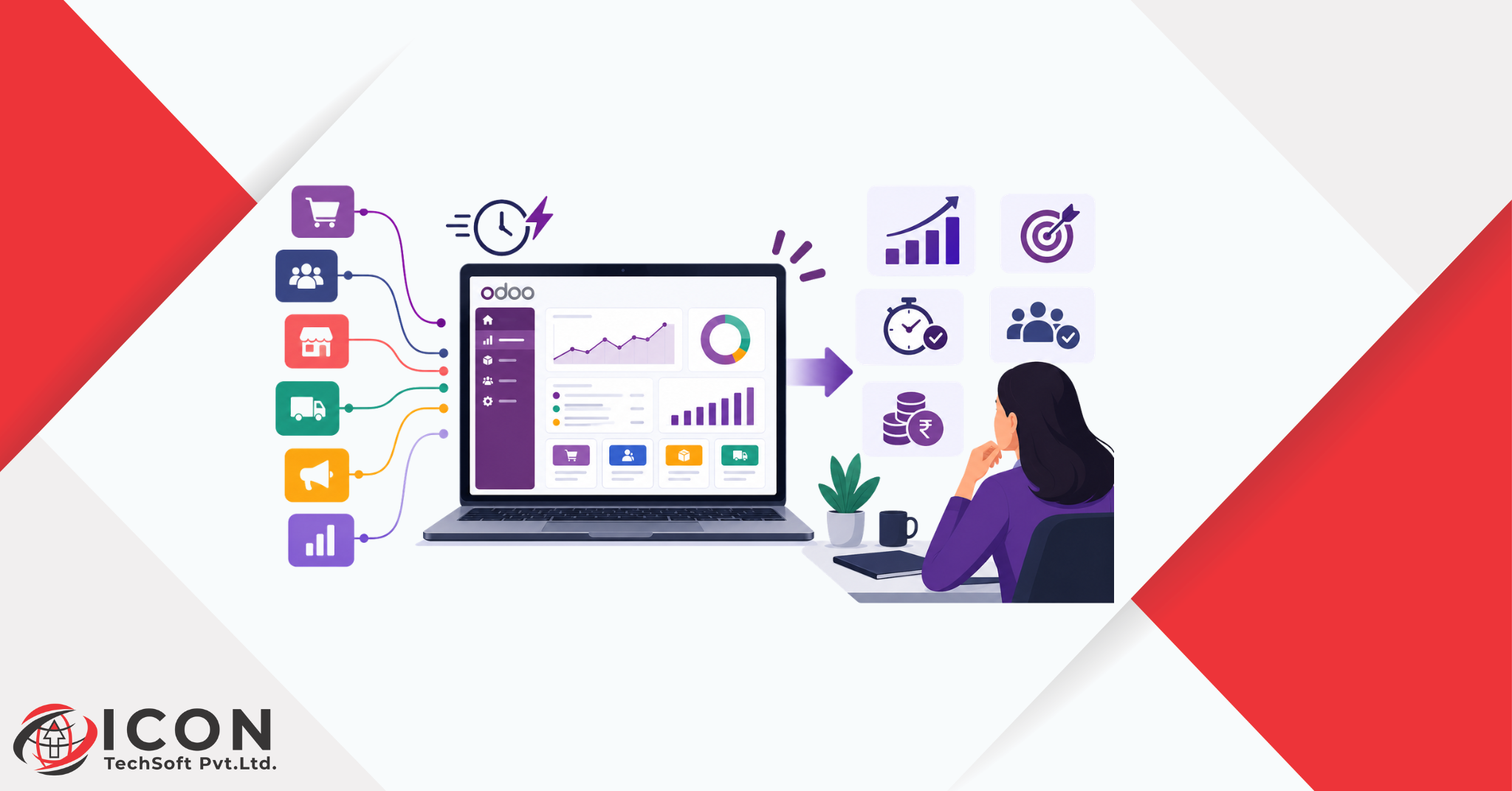
Businesses make decisions every day. They decide what to sell, when to order stock, which customers need attention, where money is being spent, and which areas of the business need improvement. But the quality of these decisions often depends on one simple thing: having the right information at the right time.
This is where real-time business data becomes important.
In the past, many businesses could operate with weekly reports, monthly spreadsheets, and information collected manually from different departments. That approach may have worked when business operations were smaller and slower. Today, customers expect faster responses, markets change quickly, and businesses manage more data than ever before.
Waiting for yesterday’s sales report to understand what is happening today can create problems. A stock shortage may not be noticed until a customer places an order. A sales manager may not know that a deal is at risk. A business owner may only discover a cash flow issue after reviewing a financial report at the end of the month.
Real-time information changes this situation.
With access to updated business information, teams can see what is happening across the organization and respond faster. Instead of relying on assumptions or outdated reports, managers can make decisions based on current information.
This is one of the reasons modern businesses are paying more attention to business data management, automation, dashboards, and integrated business systems.
An ERP platform such as Odoo ERP can bring different areas of a business together and make important information easier to access. Sales, CRM, inventory, accounting, purchasing, and other business activities can work from connected information instead of separate systems.
So, why does real-time data matter for modern businesses, and how can Odoo help?
Let’s explore it step by step.
Real-time business data is information that is available and updated as business activities happen.
For example, imagine a customer places an order through your sales team. In a connected business system, that order can immediately become part of your current sales information. Depending on the business process and configuration, related inventory, customer, invoicing, and financial information can also be updated or connected to that transaction.
The goal is simple: reduce the gap between an activity happening and the business being able to see its impact.
Real-time business data can include:
The value is not simply in collecting more data. The real value comes from making useful data available when people need it.
For example, knowing that a product sold 500 units last month is useful. Knowing that the product has already sold 200 units this week and stock is running low can be even more useful because the business has an opportunity to act before the problem becomes serious.
This is the difference between looking at data as a historical record and using data as an active business tool.
Many businesses have plenty of data but still struggle to use it effectively. The problem is often not a lack of information. It is the way information is collected, stored, shared, and updated.
When departments use separate tools and spreadsheets, important information can become disconnected. Employees may spend hours preparing reports instead of using that time to solve business problems.
Here are some of the most common challenges.
A business cannot always wait for information.
Suppose a sales manager wants to know which products are performing best this week. If the sales team needs to collect information from different files and prepare a report manually, the answer may take hours or even days.
By the time the report is ready, the situation may already have changed.
Delayed information can affect pricing, purchasing, sales planning, inventory decisions, marketing activities, and customer service.
Real-time information helps reduce this delay by giving decision-makers access to current business conditions.
Sales may use one system.
Accounting may use another.
Inventory may be tracked in spreadsheets.
Customer information may be stored somewhere else.
When systems are disconnected, employees often have to move information from one place to another. This creates unnecessary work and increases the possibility of mistakes.
It also makes it difficult for management to get a complete view of the business.
For example, a sales employee may see that an order has been placed, while the warehouse team may not have the same information immediately available. This disconnect can lead to delays and communication problems.
Connected business systems help different teams work from the same source of information.
Spreadsheets are useful and will always have a place in business. However, depending heavily on manual spreadsheets for important operational reporting can create problems.
Employees may need to:
Every manual step creates another opportunity for an error.
It also means reports may become outdated quickly.
Automated reporting and integrated business data management can reduce much of this repetitive work.
Business owners and managers need to know what is happening inside the company.
Are sales increasing?
Which products are performing well?
Which customers need attention?
How much inventory is available?
Which invoices are overdue?
What are the current expenses?
Without a connected view of the business, answering these questions can take significant time.
Real-time dashboards and reporting can make this information easier to understand and act upon.
The importance of real-time data goes beyond convenience. It can directly influence how quickly a business responds to opportunities and problems.
Here are some of the biggest advantages.
One of the clearest benefits of real-time business data is faster decision-making.
When managers have current information, they do not have to depend entirely on assumptions or old reports.
For example, if sales of a particular product suddenly increase, the business can notice the trend and review inventory levels. If a sales opportunity has been inactive for several days, the sales manager can identify it and follow up.
The decision-making process becomes more connected to what is actually happening.
This explains why understanding how real-time data improves business decision making has become increasingly important for growing organizations.
Good decisions are not only about having experience. They are also about having reliable information at the right moment.
Real-time information gives managers a clearer view of day-to-day operations.
Instead of asking different departments for updates, they can use reports and dashboards to understand important business activities.
This can help identify:
Better visibility also helps businesses identify small problems before they become larger ones.
Customers expect businesses to respond quickly.
They want to know whether an item is available, when an order will arrive, whether an invoice has been processed, and what is happening with their request.
If customer-facing employees have access to current information, they can provide answers faster.
For example, a customer service employee does not necessarily need to call the warehouse every time a customer asks about an order. If order and inventory information is available through a connected system, the employee can check the information directly.
A faster answer can create a better customer experience.
Every time employees manually copy information from one system to another, there is a possibility of an error.
A wrong number, duplicate entry, missing update, or incorrect product detail can create problems further down the process.
Integrated systems can reduce repetitive data entry and help information flow between connected business activities.
This does not mean errors disappear completely. Businesses still need proper processes, data quality checks, user permissions, and good implementation practices.
However, reducing unnecessary manual work can make daily operations more reliable.
Inventory is one area where timely information can make a major difference.
Too much inventory can tie up cash.
Too little inventory can lead to missed sales and unhappy customers.
With current inventory information, businesses can monitor stock levels and make purchasing decisions with greater confidence.
This becomes especially useful for businesses that manage many products, multiple locations, or high order volumes.
Real-time reporting turns business information into something managers can actually use.
A report is more valuable when it answers a business question.
For example:
Traditional reporting often involves collecting information first and analyzing it later.
Real-time reporting reduces this gap.
Instead of waiting for a manually prepared report, managers can use dashboards and system reports to review current information.
However, real-time reporting should not mean creating hundreds of dashboards.
The goal should be to identify the information that matters most.
A sales manager may need a sales pipeline and opportunity information.
A warehouse manager may focus on inventory and incoming shipments.
A finance manager may need invoices, payments, expenses, and financial reports.
A business owner may want a high-level view of revenue, sales, customers, inventory, and overall performance.
The right reports depend on the role and the business.
Good business data management is about more than storing information.
It involves collecting, organizing, connecting, protecting, and using business information effectively.
As companies grow, the amount of data they handle also grows. Customer records increase. Product information expands. Sales transactions become more frequent. Financial activity becomes more complex.
Without a clear system, data can become difficult to manage.
Businesses may end up with multiple versions of the same information.
For example, the sales team might have one customer phone number, while the customer service team has another. The finance department may have a different billing address. These small differences can create bigger operational problems.
A connected ERP system can help create a more consistent source of business information.
Good business data management should focus on:
Information should be correct and updated.
Authorized employees should be able to access the information they need.
Different business functions should be able to work with connected information.
Sensitive business information should be protected through appropriate access controls and security practices.
Information should be presented in a way that employees and managers can understand.
When these areas work together, data becomes more useful for everyday operations and long-term planning.
Odoo ERP is designed as an integrated business platform with applications that cover different business functions.
This integrated approach is one of the reasons businesses use Odoo to connect their operations.
Instead of managing every department separately, organizations can use connected Odoo applications and workflows.
Here are some areas where Odoo can support real-time business information.
One of the major advantages of Odoo is having business information connected within a common platform.
Depending on the applications and configuration used by a company, teams can work with information related to sales, CRM, inventory, purchasing, accounting, ecommerce, projects, and other operations.
This can reduce the need to constantly move information between separate systems.
For example, a sales order can be connected with customer information and other related business activities. The information can then support downstream processes based on how the company has configured its workflow.
This creates a more connected business environment.
Sales teams need current information to manage opportunities effectively.
Odoo CRM can help businesses organize leads, opportunities, customer interactions, sales activities, and pipelines.
A sales manager can use the available information to understand:
When CRM and sales processes are connected, teams can work with a more complete view of customer activity.
This is particularly valuable for businesses with longer sales cycles or multiple sales representatives.
Inventory information needs to be accurate and accessible.
Odoo Inventory can help businesses manage products, stock movements, warehouse operations, and related inventory processes.
Instead of relying only on manually updated spreadsheets, businesses can use system-based inventory information to understand stock conditions.
This can help teams make better decisions around purchasing, fulfillment, and order management.
For example, if a product is selling quickly, the business can review current stock and incoming inventory before making purchasing decisions.
The exact visibility available depends on the Odoo configuration and business workflow, but the key advantage is the connection between inventory activities and the broader business system.
Financial information is critical for every business.
Revenue, expenses, invoices, payments, and other financial activities influence business decisions every day.
Odoo Accounting can connect financial processes with other areas of the business.
For example, sales and invoicing can be connected within the same platform, helping finance teams reduce unnecessary manual data transfer.
Managers can also use financial information to understand business performance and make better planning decisions.
Having current financial information is especially important when a business is managing cash flow, customer payments, expenses, and growth.
Reports and dashboards can bring important business information together in a more visual format.
Instead of reading through multiple spreadsheets, managers can use relevant reports to identify trends and areas that need attention.
A good dashboard should answer important questions quickly.
For example:
The goal is not simply to make dashboards look impressive. The goal is to make information easier to understand and use.
Businesses choose different ERP solutions for different reasons, but an integrated platform such as Odoo can provide several advantages for organizations looking to improve real-time business management.
Odoo can connect different business functions through its applications and workflows.
This reduces the need to constantly switch between unrelated systems.
When information can flow between connected processes, employees may spend less time entering the same data repeatedly.
This can save time and reduce the risk of manual errors.
Sales, inventory, purchasing, accounting, and other teams can work with connected information.
This can improve communication and reduce information gaps.
Managers can access relevant reports and information without waiting for every department to prepare separate updates.
When employees have access to current customer, order, sales, and inventory information, they can respond to customer questions more efficiently.
Dashboards and reports can help managers monitor important performance indicators and identify areas that need attention.
As a business grows, its processes become more complex. An integrated ERP environment can provide a structured foundation for managing growing operations.
Consider a growing ecommerce business that sells home and lifestyle products.
The company has a sales team, warehouse, purchasing department, finance team, and customer support staff.
Before using an integrated ERP system, the company manages different activities through separate tools.
The sales team tracks orders in one system.
The warehouse maintains stock information in spreadsheets.
The finance team uses accounting software.
Customer support keeps customer information in another tool.
At the end of each week, someone has to collect information from these systems and create a report.
This process creates several problems.
The sales team may sell a product that is almost out of stock.
The warehouse may not immediately know about an urgent order.
The purchasing team may not realize that demand has increased.
The finance team may receive sales information later than expected.
Management may only discover these issues during the weekly review.
Now imagine the business using Odoo with properly connected applications and workflows.
A customer places an order.
The sales information is recorded.
Inventory-related information can reflect the order according to the configured workflow.
The warehouse team can work with the relevant order information.
Purchasing can monitor stock and replenishment requirements.
Finance can manage the related financial process.
Management can review reports to understand sales and operational performance.
The important change is not simply that the company has more software.
The important change is that business information is more connected.
This allows the company to move from asking, “What happened last week?” to asking, “What is happening now, and what should we do next?”
That is where real-time business data becomes valuable.
Traditional business data management often depends on a combination of spreadsheets, individual applications, emails, manual reports, and disconnected databases.
This approach can work for a small operation. But as the business grows, the limitations become more visible.
Consider the difference.
| Traditional Approach | Connected Odoo Approach |
| Information spread across multiple tools | Business information connected through an integrated platform |
| Manual report preparation | Automated and system-based reporting |
| Frequent spreadsheet updates | Centralized business information |
| More manual data entry | Connected workflows can reduce repetitive entry |
| Limited cross-department visibility | Better visibility across connected operations |
| Decisions based on delayed reports | Faster access to current information |
| More effort to combine data | Reports and dashboards can bring information together |
This does not mean traditional tools are always bad.
Spreadsheets, email, and specialized applications can still be useful.
The problem appears when a business depends on too many disconnected tools to manage its core operations.
At that point, the cost is not only financial.
Employees spend time looking for information.
Managers wait for reports.
Departments communicate through manual updates.
Errors become harder to identify.
And important decisions may be made using outdated information.
An integrated ERP system can help address these challenges by creating a more structured approach to business data management.
Having access to real-time data is useful, but businesses also need a plan for using it.
Simply installing an ERP system does not automatically create better decision-making.
Businesses should first understand what information actually matters.
Start by asking what managers and teams need to know.
For example:
These questions can help determine what information and reports the business needs.
Review tasks where employees repeatedly copy, update, or combine information.
Some of these processes may be candidates for automation or integration.
Reducing repetitive work gives employees more time to focus on higher-value activities.
Businesses should look at how departments interact.
Sales affects inventory.
Sales can affect invoicing.
Purchasing affects inventory.
Customer activity affects sales.
Financial activity affects planning.
When these processes are connected, the business can get more value from its information.
Do not create dashboards simply because they look modern.
Create dashboards that help people make decisions.
Each role should have access to the information relevant to its responsibilities.
Employees need to understand not only how to use the system but also why accurate data matters.
If users enter incomplete or incorrect information, reports may not provide reliable results.
Training is therefore an important part of any ERP implementation.
Real-time information is only useful when the underlying data is reliable.
Businesses should regularly review:
Good data quality creates a stronger foundation for decision-making.
Businesses do not need to transform every process at once.
They can begin with high-impact areas such as sales, CRM, inventory, accounting, or reporting.
Once the initial processes are working well, additional workflows can be improved.
This approach can make ERP adoption easier for employees and management.
The importance of real-time information is likely to continue growing.
Businesses are becoming more connected. Customers interact through websites, ecommerce platforms, mobile devices, social media, and other digital channels.
At the same time, companies are managing increasingly complex operations.
Artificial intelligence and automation are also changing how businesses use information.
But automation and AI are only as useful as the data behind them.
If business information is incomplete, outdated, or scattered, automated systems may struggle to provide useful results.
This makes connected and reliable business data increasingly important.
In the future, businesses will not only ask for reports about what happened.
They will increasingly want systems that help identify patterns, highlight unusual activity, predict potential issues, and recommend actions.
Real-time business data can provide the foundation for these capabilities.
An ERP system such as Odoo can play an important role by connecting operational information and making it easier for businesses to work with their data.
Although real-time data offers many advantages, businesses can still make mistakes when implementing it.
More data does not always mean better decisions.
Businesses should focus on useful information instead of collecting every possible metric.
If employees enter incorrect information, reports can become misleading.
Data accuracy should be treated as an ongoing responsibility.
Too many reports can make decision-making harder instead of easier.
Businesses should focus on meaningful reports that answer important questions.
Technology is only part of the process.
Employees need proper training, clear processes, and a reason to use the system correctly.
ERP implementation is a process.
Businesses may need time to configure workflows, clean data, train users, and improve processes.
A well-planned implementation can create much better long-term results than rushing through the setup.
Modern businesses compete on speed, customer experience, efficiency, and the ability to adapt.
Real-time information supports all four.
When managers can see current sales, inventory, customer activity, and financial information, they can respond faster.
When departments work with connected information, communication can improve.
When reports are automated, employees can spend less time preparing spreadsheets.
When customers receive faster and more accurate responses, their overall experience can improve.
Most importantly, real-time data helps businesses become more proactive.
Instead of waiting for a monthly report to reveal a problem, teams can identify issues earlier.
Instead of discovering a sales opportunity after it has passed, teams can act while the opportunity is still active.
Instead of guessing how inventory is performing, managers can use current information to guide purchasing and sales decisions.
This is why real-time business data is becoming a key part of modern business management.
Data has always been valuable to businesses. The difference today is how quickly businesses need to use it.
Markets move faster. Customers expect quick responses. Business operations are becoming more connected. Manual reporting and disconnected systems can make it harder to respond to change.
Real-time business data gives organizations a better way to understand what is happening and decide what to do next.
It can support faster decision-making, improve operational visibility, reduce manual work, strengthen customer service, and help businesses manage resources more effectively.
However, real-time data is only valuable when it is accurate, accessible, and connected to business processes.
This is where Odoo can make a difference.
By connecting areas such as CRM, sales, inventory, purchasing, accounting, and reporting within an integrated ERP environment, Odoo can help businesses create a more connected approach to business data management.
The goal is not simply to have more data.
The goal is to turn current information into better decisions.
For modern businesses, that ability can become a genuine competitive advantage.
When your team knows what is happening now, it becomes easier to decide what should happen next.
And that is the real value of real-time business data.