
-
Gujarat, India
- info@icontechnology.in
- 24/7 Customer Support
Gujarat, India
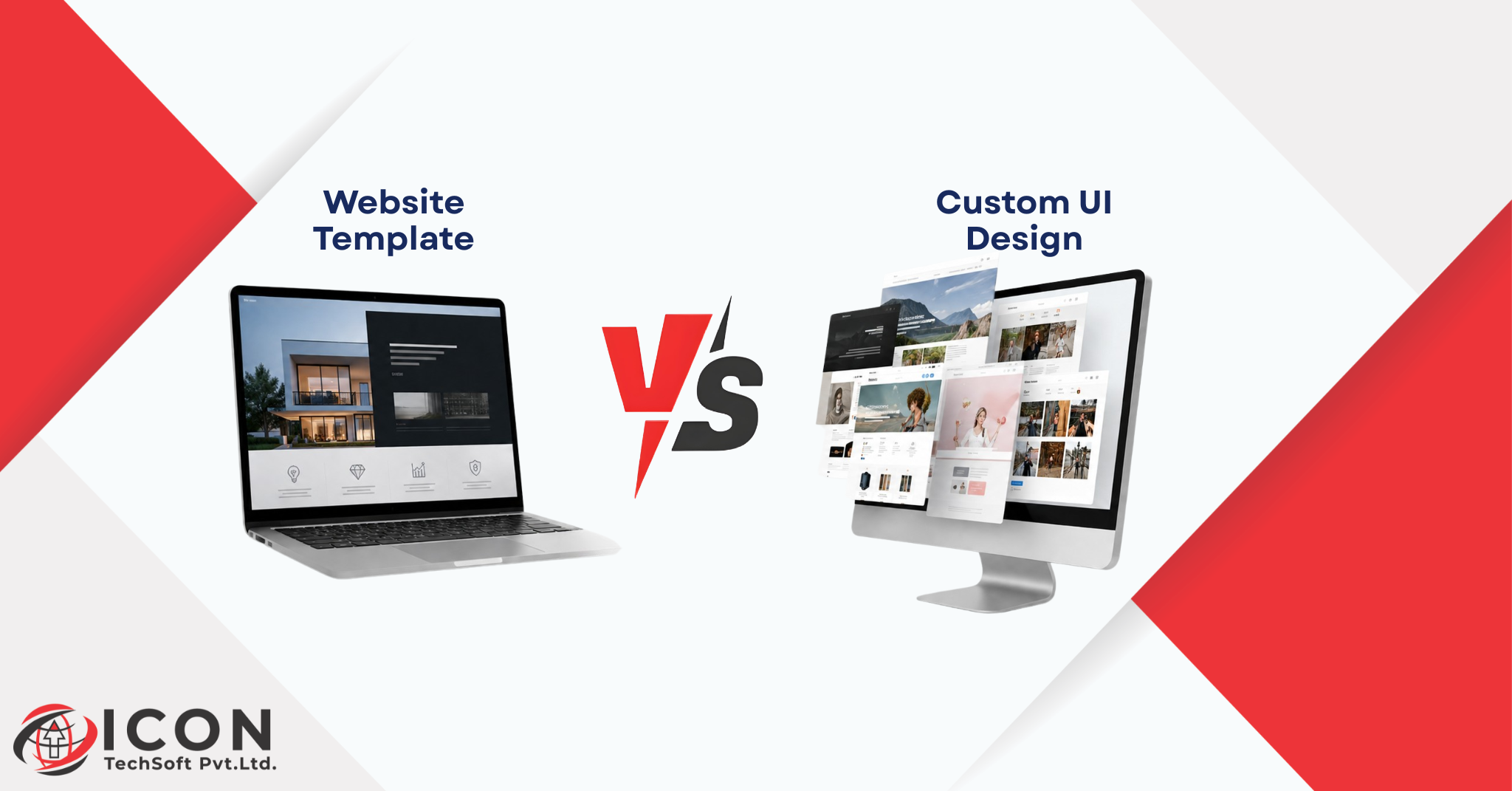
When you decide to build a website, one of the biggest questions you’ll face is whether to choose a Website Template or invest in a custom-designed website. At first glance, both options can look attractive. Templates are affordable and quick to launch, while custom designs promise a unique experience and stronger branding.
But here’s the real question:
Which one actually helps you get more leads, sales, and customers?
Many business owners focus only on appearance. They choose a beautiful website without thinking about how visitors interact with it. However, a website that looks impressive but confuses users rarely converts well.
The truth is that good design is not just about colors and layouts. It is about creating an experience that guides visitors toward taking action. Whether that action is making a purchase, filling out a contact form, or booking a consultation, every design decision affects conversions.
In this guide, you’ll learn the differences between using a Website Template and investing in a Custom Website. We’ll compare both options in terms of flexibility, user experience, SEO, performance, scalability, and cost so you can confidently choose the right solution for your business.
Choosing between a Website Template and a custom-designed website is more than a design decision. It directly affects how people perceive your brand, how easily they find information, and whether they become paying customers.
Imagine walking into two different stores.
The first store has clear signs, organized shelves, friendly staff, and an easy checkout process.
The second store has products scattered everywhere, confusing directions, and long waiting lines.
Which one would you buy from?
Your website works the same way.
Visitors make decisions within seconds. If your site feels confusing, outdated, or difficult to navigate, many users will leave before reading your content.
That’s why UI Design plays such an important role. Good design removes friction and helps visitors move naturally toward their goals.
Your website is often the first interaction someone has with your business. A strong first impression builds trust, while a poor experience creates doubt.
Your website influences:
A professionally planned Web Design isn’t just about aesthetics-it supports your business goals.
Research consistently shows that website visitors form opinions in just a few seconds.
During those first moments, people subconsciously evaluate several things:
Interestingly, visitors usually don’t think, “This is a template.”
Instead, they notice how the website makes them feel.
A professionally customized Website Template Design can appear clean and trustworthy.
On the other hand, a poorly designed custom website can feel confusing and outdated.
This means success depends less on whether you use a template or custom development and more on how well the website is planned.
Some factors that shape first impressions include:
When all these elements work together, visitors stay longer and explore more pages.
That increases the chances of conversion.
A Website Template is a pre-designed website layout that can be customized with your own content, branding, colors, and images.
Instead of building every page from scratch, you start with an existing structure.
Popular platforms like WordPress, Shopify, Wix, and Webflow offer thousands of templates designed for different industries.
Templates have become increasingly popular because they allow businesses to launch websites quickly without spending a large budget.
Faster Launch
Since the layout already exists, you can publish your website much faster than building everything from scratch.
Many businesses launch within days instead of months.
Lower Cost
Templates are significantly less expensive.
For startups and small businesses with limited budgets, this can be a huge advantage.
Beginner Friendly
Most website builders allow simple drag-and-drop editing.
You don’t need advanced coding skills to update content or images.
Responsive Design
Modern templates usually adapt automatically to different screen sizes.
This ensures your website works well on desktops, tablets, and smartphones.
Large Selection
There are templates available for almost every business category, including:
Finding a design close to your business needs is relatively easy.
Although templates offer convenience, they also come with restrictions.
Limited Design Freedom
You’re working within an existing framework.
Some sections can be modified, but major layout changes may require coding or may not be possible at all.
Generic Appearance
Popular templates are often used by thousands of websites.
Even after customization, your website may still look similar to competitors.
Extra Features You May Never Use
Many templates include numerous built-in components, animations, widgets, and scripts.
If these aren’t optimized, they can slow down your website.
Customization Challenges
As your business grows, adding unique features may become difficult.
Complex integrations sometimes require developers to work around the template’s limitations.
Scalability Issues
Templates work well for smaller websites.
However, businesses that require advanced booking systems, customer dashboards, or personalized workflows may eventually outgrow them.
A Website Template is often the right choice if:
For many startups, freelancers, and local businesses, a template provides an excellent starting point.
The key is choosing a well-built template and customizing it carefully instead of leaving it exactly as it comes.
Unlike templates, a Custom Website is designed specifically for your business, your audience, and your goals.
Every page, button, animation, layout, and user journey is created from the ground up.
Instead of adapting your business to fit a template, the website is built around your business.
This creates a much more personalized experience for visitors.
Professional custom projects rarely begin with designing pages.
They begin with understanding your business.
Designers typically ask questions like:
The answers shape the entire design process.
Every element exists for a purpose.
Effective UI Design is about helping users complete tasks with minimal effort.
Instead of forcing visitors to figure things out, custom interfaces guide them naturally.
Examples include:
These improvements reduce friction and often lead to higher conversion rates.
Your website should look like your business-not like thousands of others.
A custom design allows you to create:
This helps visitors remember your brand long after they leave your website.
A strong identity also builds credibility, especially in competitive industries.
One of the biggest advantages of a Custom Website is flexibility.
As your business evolves, your website can evolve too.
Need to add:
A custom-built website makes these additions much easier because the foundation was designed with scalability in mind.
Instead of replacing your website after a few years, you can continue improving it as your business grows.
Now that you understand what a Website Template and a Custom Website are, it’s time to compare them side by side.
Many business owners believe one option is always better than the other. In reality, the right choice depends on your goals, budget, timeline, and future plans.
Let’s compare both options across the factors that matter most.
One of the biggest differences between a Website Template and a custom-built website is how much creative freedom you have.
A template already comes with a predefined structure. You can usually change colors, fonts, images, and some layouts, but the overall design follows the original framework. If you want to make major structural changes, you may need custom coding, and some changes might not even be possible.
A Custom Website, on the other hand, starts with a blank canvas. Every section is created specifically for your business. Designers can place content exactly where it works best instead of fitting everything into a fixed layout.
Website Template
Advantages
Limitations
Custom Website
Advantages
Limitations
If your brand depends heavily on standing out from competitors, a Custom Website offers far greater flexibility.
A beautiful website is only successful if visitors can use it easily.
This is where UI Design becomes essential.
Good user experience removes confusion. Visitors should know where to click, how to navigate, and what action to take next without thinking too hard.
Templates often include layouts designed for general audiences. While many work well, they may not perfectly match your specific customer journey.
For example, a law firm, an online clothing store, and a software company all have different customer expectations. A generic layout may not support each journey equally well.
Custom websites are designed after understanding user behavior.
Designers can optimize:
These improvements make visitors feel more comfortable and increase the chances of conversion.
Which Performs Better?
If your business relies on generating leads or online sales, investing in better UI Design often produces measurable improvements.
Website speed affects both user satisfaction and search engine rankings.
People expect pages to load quickly. Even a delay of a few seconds can increase bounce rates.
Many templates include extra features that every business may not need.
Examples include:
These features can increase loading time if they are not optimized.
A custom-built website usually includes only the features your business requires.
That means:
Regardless of which option you choose, optimization remains important.
Simple improvements include:
A well-optimized Website Template can still perform very well, but custom websites generally have greater performance potential.
A stunning website has little value if people cannot find it.
Good Web Design supports search engine optimization by making your content easier for both users and search engines to understand.
Many modern templates include SEO-friendly features such as:
However, not every template follows SEO best practices.
Some templates generate unnecessary code that makes pages heavier than needed.
Custom websites give developers complete control over technical SEO elements, including:
Content quality still plays the biggest role in SEO, but technical optimization provides a strong foundation.
Whether you choose a Website Template or a Custom Website, publishing helpful content consistently is what drives long-term organic traffic.
Budget is often the deciding factor.
Templates usually require less time and money because much of the design work has already been completed.
Typical costs include:
Many businesses can launch within a few days or weeks.
Custom websites involve:
Because everything is built specifically for your business, the process takes longer and costs more.
Website Template
Best for
Custom Website
Best for
Instead of asking which option is cheaper, ask which one offers the better return on investment over the next several years.
Businesses rarely stay the same forever.
As your company grows, your website needs to grow with it.
You may eventually want to add:
Templates can support some of these features through plugins.
However, adding too many plugins can increase maintenance challenges and reduce performance.
A Custom Website is built with future expansion in mind.
Developers can create a flexible architecture that supports new features without redesigning the entire website.
If rapid growth is part of your business strategy, scalability becomes a major advantage.
Every website requires ongoing maintenance.
This includes:
Templates often depend on third-party themes and plugins.
If one component stops receiving updates, compatibility issues can appear.
Custom websites usually contain fewer unnecessary dependencies, making maintenance more controlled.
However, they may require experienced developers for future improvements.
Regardless of which option you choose, regular maintenance helps protect your website from security risks and performance problems.
This is the question that matters most.
Does a Website Template convert better than a custom-designed website?
The honest answer is:
Neither wins automatically.
Conversions depend on how well your website solves user problems.
A professionally customized template can outperform a poorly planned custom website.
Likewise, a strategically designed custom website can significantly outperform an average template.
The highest-converting websites usually share these characteristics:
These factors influence user decisions far more than whether the site started from a template.
That said, custom websites provide greater freedom to optimize every step of the customer journey.
As businesses grow, even small improvements in conversion rates can lead to substantial increases in revenue.
For example, imagine a website receives 10,000 monthly visitors.
If conversion improves from 2% to 3%, that’s a 50% increase in customers without spending more on advertising.
This is why businesses focused on long-term growth often invest in custom optimization.
A Website Template is an excellent solution in many situations.
Choose a template if:
Templates also work well for:
With thoughtful customization and strong content, a template can still deliver impressive results.
A Custom Website becomes a smart investment when your website directly supports business growth.
You should consider custom development if:
Custom websites are especially valuable for:
These businesses often benefit from personalized UI Design because every improvement can directly increase customer engagement and revenue.
A well-planned Website Template Design can perform much better than many people expect.
If you’re using a template, these tips can help increase conversions.
Replace default:
This helps your website look unique instead of resembling hundreds of other websites.
Limit your main navigation to the most important pages.
Too many menu options often confuse visitors.
Every page should encourage one main action.
Examples include:
Avoid overwhelming visitors with too many choices.
People buy from businesses they trust.
Add elements like:
These build confidence and encourage visitors to take action.
Large images slow websites down.
Compress images before uploading them while maintaining good quality.
Fast websites create better user experiences.
Small improvements can lead to significant results.
Test different versions of:
Continuous optimization often increases conversion rates over time.
Different businesses have different requirements.
Let’s see which option usually works best.
Personal Portfolio
A portfolio typically includes:
For most freelancers, designers, photographers, writers, and consultants, a Website Template provides everything needed.
Choose a clean, modern design and customize it with your own branding.
Startup
Startups usually have limited budgets and need to launch quickly.
A template can be a practical choice during the early stages.
As the company grows and customer needs become more advanced, moving to a Custom Website becomes a worthwhile investment.
Small Business
Local businesses often need:
A well-designed Website Template is often enough.
However, businesses competing in highly competitive markets may benefit from custom features that improve user experience.
eCommerce Store
Online stores need:
Small stores can perform well with a template.
Larger stores with thousands of products often benefit from custom development because it allows better performance, scalability, and personalized shopping experiences.
Growing Brand
A growing business usually requires:
In these situations, investing in a Custom Website often provides greater long-term value.
Is a Website Template good for SEO?
Yes. A modern Website Template can perform well in search engines when combined with quality content, fast loading speeds, proper optimization, and good technical SEO practices.
Can a Website Template look professional?
Absolutely.
Many premium templates look highly professional when customized with unique branding, quality images, and original content.
Is a Custom Website always better?
Not necessarily.
If your business has simple requirements, a professionally customized template can provide excellent results at a lower cost.
Which option converts better?
Conversions depend more on user experience, content, speed, and trust than on whether the website uses a template or custom development.
However, custom websites provide greater flexibility for optimizing the customer journey.
Can I start with a template and upgrade later?
Yes.
Many businesses begin with a Website Template and move to a custom solution once their business grows and their website requirements become more complex.